Getting out of a merchant cash advance means choosing from six real paths — renegotiation, structured restructuring, refinancing, a legal contract review, settlement, or bankruptcy — never a second MCA taken out to cover the first. The paths that work address the debt you already have directly; reverse consolidation just adds a new one on top of it.
What's Actually Happening When an MCA Turns Into a Trap
A merchant cash advance isn't a loan — it's a sale of a slice of future revenue, repaid through daily or weekly ACH debits pulled directly from your bank account or card processor. That structure is what makes it dangerous once cash flow tightens: the debits don't pause for a slow week, a late invoice, or a piece of equipment breaking down.
Factor rates typically run from about 1.1 to 1.5, so a $50,000 advance can cost $55,000 to $75,000 to repay — a cost structure that, expressed as an annual rate, often runs into triple digits. When a business takes a second advance to cover the first, or sales dip and the fixed daily pull starts eating payroll, the debt stops behaving like financing and starts behaving like a structural drain.
Understanding how MCA debt actually works matters, because the exit options below depend on where you are in that cycle — one advance or several, current or already behind, and whether a confession of judgment or personal guarantee is attached.
Is a Merchant Cash Advance Legal?
Yes — merchant cash advances are legal in the United States. Because a true MCA is structured as a purchase of future receivables rather than a loan, it generally falls outside the interest-rate caps that apply to lending. That's the legal basis the entire industry rests on, and it's also why MCA contracts are written so carefully around the language of "purchase" rather than "loan."
The legality gets less clean-cut at the edges. Some MCA contracts function so much like a loan — a fixed repayment amount regardless of sales, a fixed term, personal guarantees, a confession of judgment — that courts have, in some cases, recharacterized them as loans and applied usury protections. Whether that argument holds depends heavily on how a specific contract is written and which state's law applies, which is exactly why "is my MCA legal" is a question for a review of your actual agreement, not a blanket answer.
None of this means every aggressive MCA practice is beyond scrutiny. It means the product itself is legal; the argument, when there is one, is usually over whether a specific contract was actually a disguised loan.
Six Real Ways Out of a Merchant Cash Advance
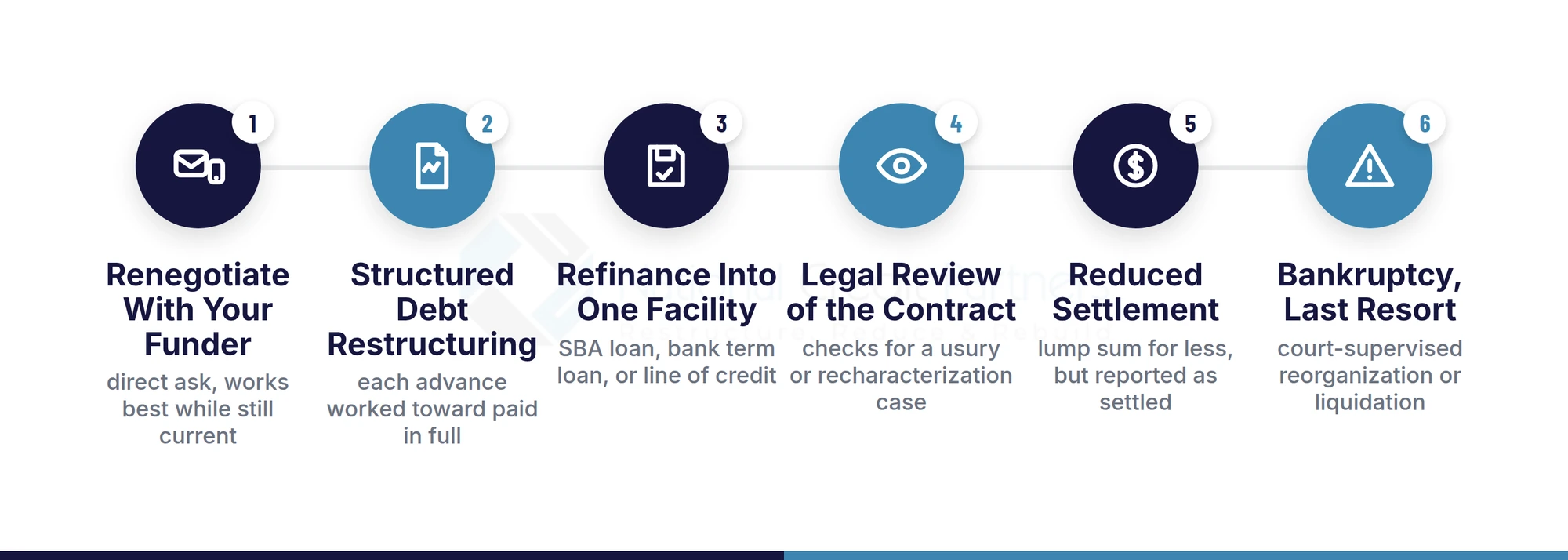
Every business owner searching for a way out lands on some version of the same six paths. They are not equally safe or interchangeable — the right one depends on how many advances you're carrying, how far behind you are, and whether legal pressure has already started. Here they are, ordered roughly from lowest risk to highest.
1. Renegotiate Directly With Your Funder
Some funders will adjust a payment schedule for a business that's still current but under strain — especially if the alternative is a default that gets them nothing. This works best before you've missed a payment, and it rarely produces more than a temporary adjustment, since the contract still legally entitles the funder to full repayment. Useful as a stopgap; not a fix if you're carrying more than one advance.
2. Structured Debt Restructuring
A negotiated, out-of-court process that works directly with each creditor — often across several advances at once — to bring payments back in line with what the business actually generates, with each obligation worked toward paid in full rather than settled for less. This is the approach National Credit Partners calls structured reconciliation: it addresses the existing debt directly, without adding new borrowing on top. Typically the strongest option once more than one advance is stacked or a payment has already been missed.
3. Refinance Into a Single, Lower-Cost Facility
If credit and cash flow still qualify, replacing high-cost MCA debt with an SBA loan, bank term loan, or business line of credit can lower total cost and combine several payments into one. The catch: qualifying usually requires the debt load to already be under control — refinancing tends to work best after restructuring has stabilized the business, not as the first move while multiple daily debits are still hitting the account.
4. Get a Legal Review of the Contract
If a contract has features that look more like a loan than a receivables purchase — a fixed repayment amount, a confession of judgment, aggressive collection language — an attorney can review whether a genuine usury or recharacterization argument exists. It's a real option, but it's contract- and state-specific, takes time, and usually works alongside restructuring rather than replacing it.
5. Negotiate a Reduced Settlement
Some businesses pursue a lump-sum settlement for less than the full balance owed, usually through a debt settlement firm. It can reduce the total dollar amount, but settled accounts are commonly reported as such — a mark against future financing — and the process can take months, during which the funder may continue collection. It's a different route from restructuring, which works toward the debt being paid in full on workable terms rather than reduced and reported as settled.
6. Bankruptcy, as a Last Resort
When the debt is genuinely unpayable and legal pressure has escalated, Chapter 11 — including the streamlined small-business track, Subchapter V — lets a business reorganize under court supervision and keep operating, while Chapter 7 liquidates it. Both carry lasting credit, cost, and control consequences, and which one applies, if any, is a decision for a bankruptcy attorney based on your actual numbers. The highest-risk option on this list, which is exactly why it belongs last.
The Reverse Consolidation Trap: Why a Second MCA Never Fixes the First
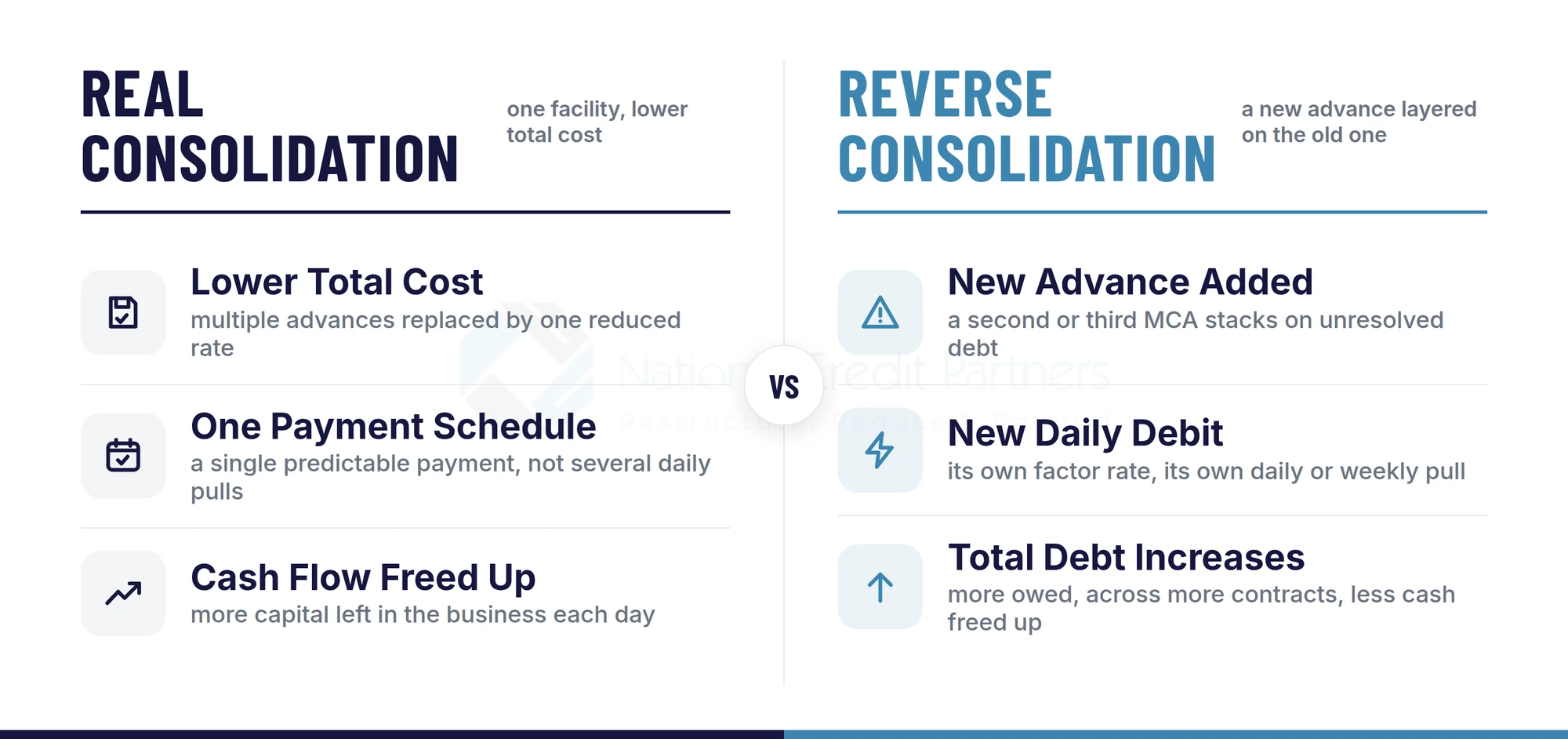
Reverse consolidation shows up constantly in searches for MCA relief, and it deserves a direct warning: it means taking out a second, or third, merchant cash advance specifically to cover the daily or weekly payments on the first. It's marketed as a way to "consolidate" MCA debt — but it does the opposite of what consolidation is supposed to do.
Real consolidation replaces multiple obligations with one, at a lower total cost. Reverse consolidation adds a new advance — its own factor rate, its own daily debit, often its own confession of judgment — on top of debt that was already unmanageable. It's functionally the same mechanism as MCA stacking: multiple funders pulling from the same account, each increasing the total daily drain instead of reducing it.
It isn't automatically illegal, and it isn't always sold in bad faith. But mechanically it almost never buys anything except a bigger hole: the business owes more in total, across more contracts, with less cash freed up each day than before. If you're offered a new advance to cover payments on an existing one, that's the moment to get the debt restructured instead of stacking another one on top of it.
What Happens If You Default
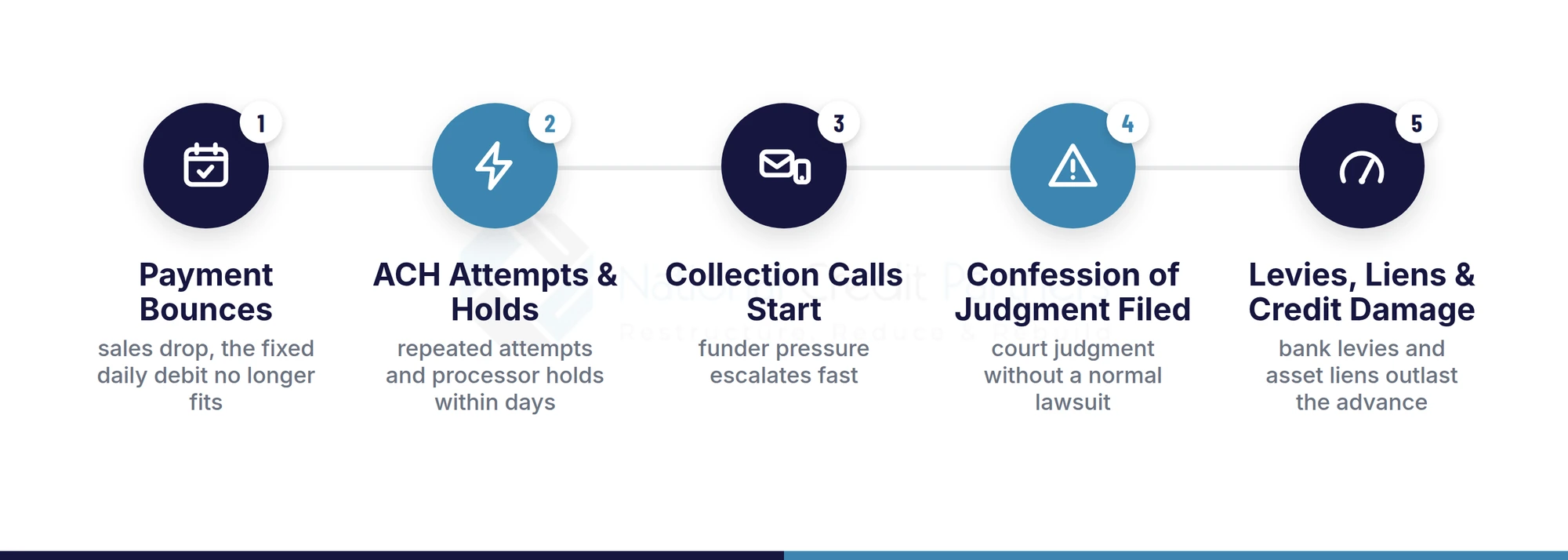
Default on an MCA typically starts the same way for most businesses: sales drop, the fixed or percentage-based debit no longer fits what's coming in, and payments start bouncing or triggering account holds. From there, funders move fast — daily ACH attempts, card processor holds, and collection calls usually begin within days, not months.
If your contract includes a confession of judgment, the funder can, in some states, obtain a court judgment against the business — and against you personally if you signed a personal guarantee — without the normal court process a lawsuit would require. That judgment can lead to bank levies, liens against business assets, and damage to both business and personal credit that outlasts the advance itself.
None of this is a reason to wait and see what happens. The consequences of default escalate the longer a business goes without addressing the debt directly, and the options for a negotiated resolution generally narrow once legal action has actually started.
Which Option Fits Your Situation
A rough way to think about it: if you're carrying one advance and still current, direct renegotiation or refinancing may be enough. If you're carrying two or more, already behind, or being offered a new advance to cover an old one, restructuring the debt directly — before a new contract or a lawsuit narrows your options further — is usually the more durable move. If legal action has already started or the numbers genuinely don't work under any structure, that's when a bankruptcy attorney needs to be in the conversation.
There isn't a single right answer that fits every business, because it depends on how many advances are stacked, how far into default you are, and what's already been signed. A conversation with a specialist who can review your actual contracts is the fastest way to find out which of the paths above actually applies to you — not the version a search result assumes.
Frequently Asked Questions
Are MCA loans legal?
Yes. A merchant cash advance is structured as a purchase of future receivables rather than a loan, which is why it generally isn't subject to the interest-rate caps that apply to lending. Some contracts function so closely like a loan — fixed payments, personal guarantees, a confession of judgment — that courts have, in some cases, recharacterized them and applied usury protections. Whether that applies to your situation depends on the specific contract and state law.
Is reverse consolidation a scam?
Reverse consolidation — taking a new merchant cash advance to cover payments on an existing one — isn't automatically fraudulent, but it rarely does what it's marketed to do. Real consolidation lowers your total cost and combines obligations into one; reverse consolidation adds a new advance, a new factor rate, and often a new confession of judgment on top of the debt that was already unmanageable. Treat any offer framed this way with real caution.
Can you get out of an MCA before the term ends?
It depends on the contract. Because an MCA is a sale of future receivables rather than a loan, many agreements don't include a discounted early-payoff structure the way a traditional loan would — the factor rate is often fixed regardless of how quickly you repay it. Some funders will negotiate an early buyout; others won't unless pressed. Reviewing the actual contract terms is the only way to know for certain.
What happens if you default on a merchant cash advance?
Default typically triggers immediate collection activity: repeated ACH attempts, card processor holds, and in many cases a confession of judgment that lets the funder obtain a court judgment quickly, sometimes against you personally if a personal guarantee was signed. Business and personal credit can both be affected, and options for a negotiated resolution generally narrow the longer default continues.
Is MCA debt dischargeable in bankruptcy?
It depends on the chapter filed and the specific debt. As business debt, MCA obligations are generally addressed within a Chapter 7 or Chapter 11/Subchapter V filing, but secured claims tied to a UCC lien and personal guarantees can survive differently than unsecured debt. This is exactly the kind of detail a bankruptcy attorney needs to confirm against your actual contracts, not a general answer.
How fast can you get relief from MCA debt?
Timelines vary with how many advances are stacked, whether you're already in default, and whether legal action has started — the earlier a business acts, the more options and the more time restructuring generally takes to negotiate compared with dealing with a single lender. There's no fixed number that applies to every business; a review of your specific advances is the only way to get an actual timeline.
Final Thoughts
Every one of the six paths above is a real, legitimate way out of an MCA — but they carry very different levels of risk, and the worst move available is the one that looks like progress: taking a new advance to service an old one. Reverse consolidation feels like action. It is usually the opposite of it. The businesses that get out cleanest are the ones that stop, map exactly what they owe and to whom, and choose a path deliberately instead of reacting to whichever funder or broker calls first. That mapping is where a real conversation about your options should start.
We are proud to be an A+ BBB Rated Company
An A+ rating represents BBB's high degree of confidence that the business is operating in a trustworthy manner and will make a good faith effort to resolve any customer concerns filed with the BBB.