

When you sign a personal guarantee on a merchant cash advance and the business defaults, the guarantee lets the funder pursue you personally, not just the company, so your bank accounts, home equity, and personal property can be exposed. What is actually collectible depends on the guarantee's wording, your state's exemptions, and whether the underlying MCA agreement is enforceable at all.
The daily debits stopped covering themselves, the account is short, and now the funder is talking about you by name instead of your company. That shift is the whole point of the personal guarantee you signed when you took the merchant cash advance. It is the line in the contract that lets a funder reach past your LLC and pursue your own bank account, your savings, and, in some cases, the equity in your home. This is general information, not legal advice, but understanding exactly what that clause does, and does not, allow is the difference between panic and a plan.
An MCA is usually structured as a purchase of your future receivables rather than a loan. That structure is why funders can move fast and why the same lending rules that cap interest on a bank loan often do not apply. But it also means the advance is not secured by real collateral in the traditional sense. To close that gap, most funders add a personal guarantee.
The business obligation and your personal liability are two separate things. Your company owes the outstanding balance under the advance. The personal guarantee is a second, standalone promise: if the business cannot pay, you will, out of your own finances. Forming an LLC or corporation normally shields your personal assets from business debts, but a personal guarantee is a voluntary waiver of exactly that protection. Signing it puts your name on the hook alongside the company's.
A point business owners miss until it is too late: "no collateral required" and "unsecured" describe the advance, not your exposure. An MCA can be unsecured against business assets and still carry a full personal guarantee. Where a business has more than one owner, funders frequently require each of them to sign, either jointly (each owner liable for the whole balance) or proportionally (liable up to their ownership share). A minority stake does not automatically mean a minority obligation, so the specific wording controls.
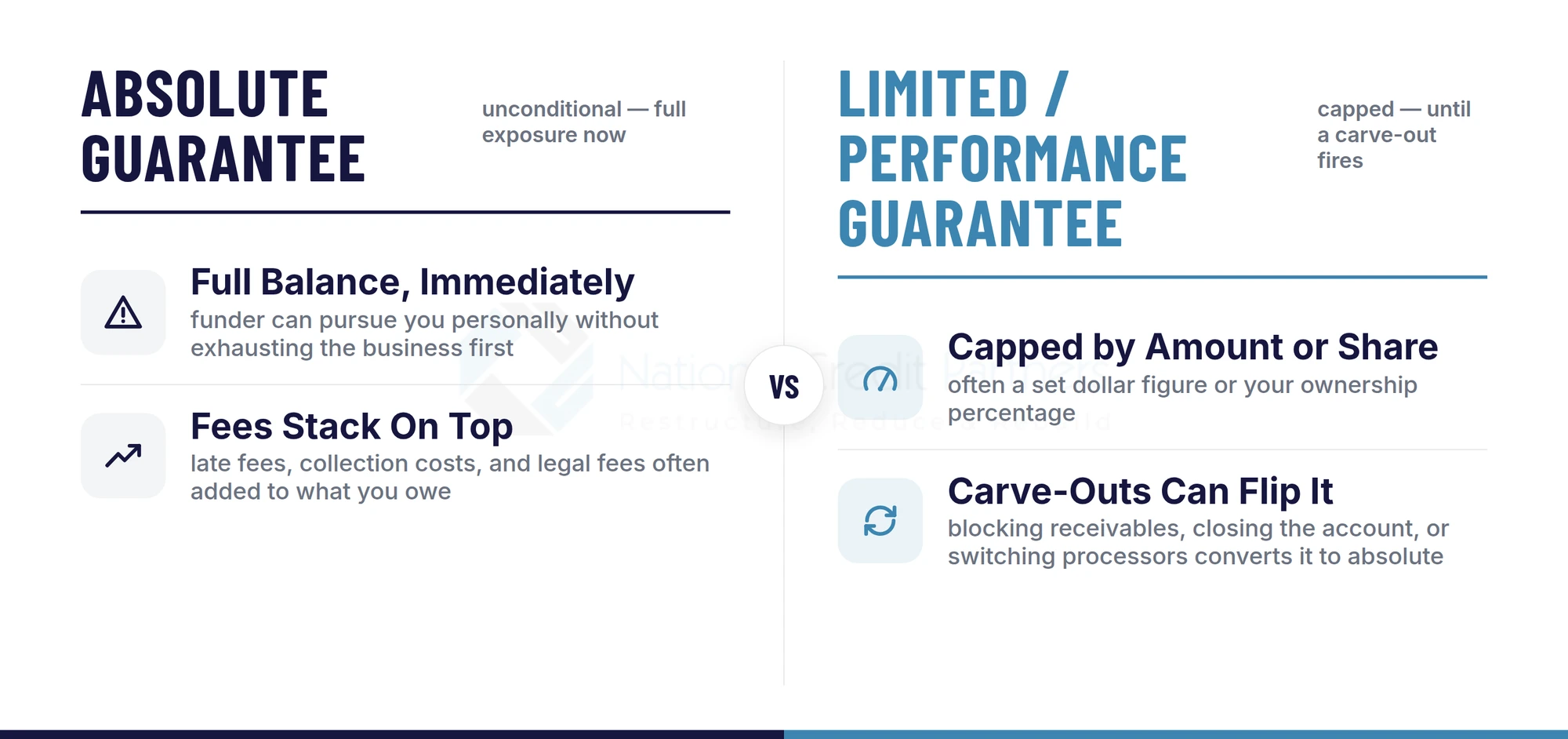
Not every guarantee is written the same way, and the type you signed changes how quickly, and for how much, you can be pursued.
An absolute (or unconditional) guarantee makes you liable for the full outstanding balance the moment the business defaults, often including late fees, collection costs, and legal fees. The funder can come after you directly without first exhausting the company. A limited guarantee caps your exposure, commonly at a set dollar figure or your ownership percentage, so a 25% owner might be liable for roughly a quarter of the unpaid balance rather than all of it.
There is a second, more subtle layer that trips people up. Some advances are marketed with softer, "performance"-style language suggesting you are only guaranteeing that the business will keep processing revenue in good faith, not the debt itself, right up until you trigger a carve-out. These agreements typically list events that convert a limited guarantee into full personal liability: blocking or diverting the receivables the funder bought, closing the business bank account, switching payment processors to dodge the debits, or making a material misrepresentation on the application. Cross one of those lines and a "limited" guarantee can flip to an absolute one covering the entire balance. If you are in distress, read the guarantee for these triggers before you change how money moves through your accounts, because the instinctive survival move (moving your deposits) can be the exact act that maximizes your personal liability. Our breakdown of what really happens if you stop paying an MCA walks through how default escalates from missed debit to collection.

Once a personal guarantee is in play and the business has defaulted, the funder's goal is a judgment against you personally, and then collection against your assets. In general terms, the assets most commonly exposed are:
The tools a funder can use after obtaining a judgment typically include bank levies, liens on real estate, and, in some situations, garnishment. If the agreement contains a confession of judgment clause, the funder may be able to obtain that judgment quickly and with limited notice, which is what makes a frozen bank account feel like it came out of nowhere.
Some assets are commonly protected, but the protection is not automatic and is not the same everywhere. Retirement accounts such as 401(k)s and IRAs often have strong protection from creditors. Homestead exemptions can shield some or all of a primary residence's equity, and certain wage protections limit what can be garnished. The critical caveat: these are state-law protections, they vary widely, and none of them is a substitute for advice from a qualified attorney about your specific situation. Treat the list above as a map of where to focus, not a guarantee of outcome.
Two business owners with nearly identical MCA guarantees can face very different exposure simply because of where they live and where the funder tries to collect. Homestead exemptions are the clearest example: some states protect a generous amount of home equity from creditors while others protect very little, so the same personal judgment reaches your house in one state and stops at the door in another. Wage garnishment limits, exemptions for personal property, and the treatment of jointly owned assets all differ by jurisdiction too.
Confession of judgment clauses are another moving target. They are banned or heavily restricted in a number of states because of their potential for abuse, and regulators in states including New York and California have moved to limit their use against small businesses. Whether a COJ signed in one state can be enforced against you in another is a genuinely complicated legal question, not a settled rule. This is exactly the kind of state-specific detail no article should answer for you: the right move is to have a licensed attorney in your state read your actual agreement rather than rely on a general summary.

Here is the part funders would rather you not dwell on: a personal guarantee is attached to the MCA agreement, and that underlying agreement is not automatically ironclad. Courts have increasingly looked past the "purchase of receivables" label to the substance of the deal. If an MCA has loan-like features, fixed payments that do not flex with actual revenue, a defined repayment term, and penalties for default, a court may treat it as a disguised loan, which can expose it to state usury laws it was written to avoid.
New York courts have wrestled with exactly this. In LG Funding, LLC v. United Senior Properties of Olathe, LLC (181 A.D.3d 664, 2020), the Appellate Division examined whether an MCA was a true receivables purchase or a loan disguised to sidestep criminal usury limits. A later decision, Principis Capital v. I Do Inc. (201 A.D.3d 752, 2022), distinguished its facts and reached a different result, which is the point: enforceability is fact-specific, not a foregone conclusion. Federal regulators including the FTC and CFPB have also scrutinized deceptive MCA practices. Guarantees and asset-seizure clauses that appear unconscionable or were obtained through misleading tactics can be challenged.
None of this means you should stop paying and assume a court will rescue you, and National Credit Partners is not a law firm and does not provide legal advice or representation. It means the guarantee's real-world strength depends on the contract it sits on, and that is worth having reviewed rather than accepting the funder's word that you have no options. Ignoring the problem is its own decision with a price; we lay out that math in the cost of doing nothing about business debt.
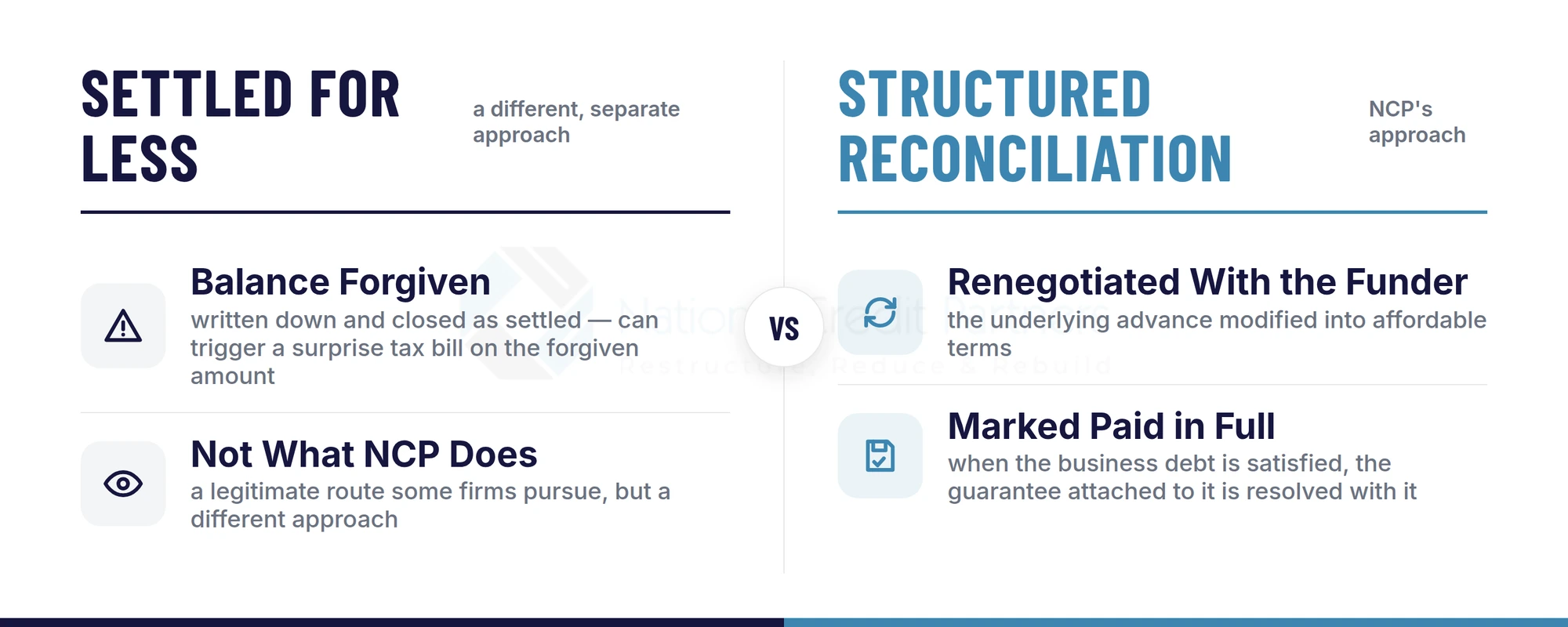
A personal guarantee only becomes a personal judgment if the underlying business debt goes unresolved and the funder wins in collection. Resolve the business debt on workable terms and, in most cases, the guarantee never has to be tested against your house.
That is the logic behind structured reconciliation. Rather than settling a balance for less than owed, National Credit Partners works to renegotiate the underlying advance directly with the funder into modified, affordable terms, with the goal of the debt being marked paid in full. When the business obligation is satisfied on agreed terms, the personal guarantee attached to it is resolved along with it, without a personal judgment hanging over your bank account. This is deliberately different from debt settlement, where a forgiven balance can create its own problems, including a surprise tax bill on the forgiven amount. We cover that trap in smart debt restructuring tips to avoid tax surprises.
To be clear about the landscape: this is one route among several, and the right one depends on your numbers, your agreement, and your state. Where the exposure is legal, you need a qualified attorney. Where the exposure is a business debt you can no longer service on its current terms, restructuring the debt so the guarantee never fires is often the more durable fix than trying to shelter assets after a judgment has already landed.
If your business carries $50,000 or more in MCA or other business debt and you are personally on the hook through a guarantee, you can schedule a free consultation to talk through whether structured reconciliation fits your situation. It is a conversation about your options, not a commitment.
Many are, but not all. Whether an MCA carries a personal guarantee depends on the funder and the specific agreement. Some funders require one because the advance is not backed by hard collateral; others, particularly those underwriting on strong, verifiable revenue, may not. Because "no collateral" does not mean "no personal liability," the only reliable way to know is to read the guarantee section of your own contract before you sign.
The main risks are high effective cost (factor rates rather than interest can translate to steep annualized costs), daily or weekly debits that drain cash flow, aggressive contract clauses such as confessions of judgment, UCC-1 liens over business assets, personal guarantees that expose your own assets, and stacking, where a second advance taken to cover the first compounds into a default spiral.
Yes, a properly executed personal guarantee is generally enforceable, which is why it should never be signed casually. That said, enforceability is not absolute. A guarantee can be challenged where the underlying agreement is unconscionable, was obtained through misrepresentation, or where the MCA itself functions as a disguised usurious loan. Whether a challenge succeeds is fact-specific and a question for a licensed attorney.
MCAs are generally treated as commercial purchases of future receivables rather than loans, which is why interest-rate caps and many lending disclosure rules do not apply to them. They are not illegal, but they must follow fair business practices. Courts in states such as California and New York have invalidated or restricted MCA contracts that operate as disguised loans violating state lending laws, so the label alone does not make every term enforceable.
No. An LLC or corporation normally shields your personal assets from business debts, but a personal guarantee is a voluntary waiver of that shield for the guaranteed debt. Once you sign, the funder can pursue you personally regardless of the business structure, which is why the guarantee clause deserves as much scrutiny as the cost of the advance.
It can address the debt the guarantee is attached to. By renegotiating the underlying advance into modified terms marked paid in full rather than settled for less, the goal is to resolve the business obligation so the personal guarantee is satisfied without a personal judgment. National Credit Partners is not a law firm; for the legal enforceability of a guarantee, consult qualified counsel.
A personal guarantee turns a business problem into a personal one, but signing it is not the same as losing. What you are actually exposed to depends on how the guarantee is written, what your state protects, and whether the MCA agreement behind it holds up at all. Deal with the underlying debt on workable terms before it becomes a judgment, get a qualified attorney on the legal questions, and you keep far more control than the funder's collection calls suggest.
An A+ rating represents BBB's high degree of confidence that the business is operating in a trustworthy manner and will make a good faith effort to resolve any customer concerns filed with the BBB.