

MCA stacking is taking a second, third, or fourth merchant cash advance while an earlier one is still being repaid, so several funders debit the same bank account every business day. The combined daily drain usually outpaces revenue long before the balances are paid, which is why stacking is the pattern behind most MCA-driven business failures and why the way out is renegotiating all positions at once rather than borrowing again.
Stacking is taking a new merchant cash advance while an earlier advance is still outstanding, so two or more funders are collecting from your business at the same time. In the industry the advances are called positions, numbered in the order they were funded: the first funder holds the first position, the next holds the second, and so on. Each position is a separate contract, a separate daily or weekly ACH debit, and a separate claim against your future receivables.
That last part is what makes stacking different from carrying two ordinary loans. An MCA is not structured as a loan at all. It is written as a purchase of your future sales, repaid by fixed automatic debits from your operating account until the agreed amount is collected in full. Add a second position and a third, and you now have several parties reaching into one bank account every morning, each one contractually entitled to its slice of the same revenue.
If you want the underlying mechanics of how a single advance is priced and repaid before you read further, our breakdown of how merchant cash advances really work in 2026 covers the factor-rate and holdback basics this page builds on.
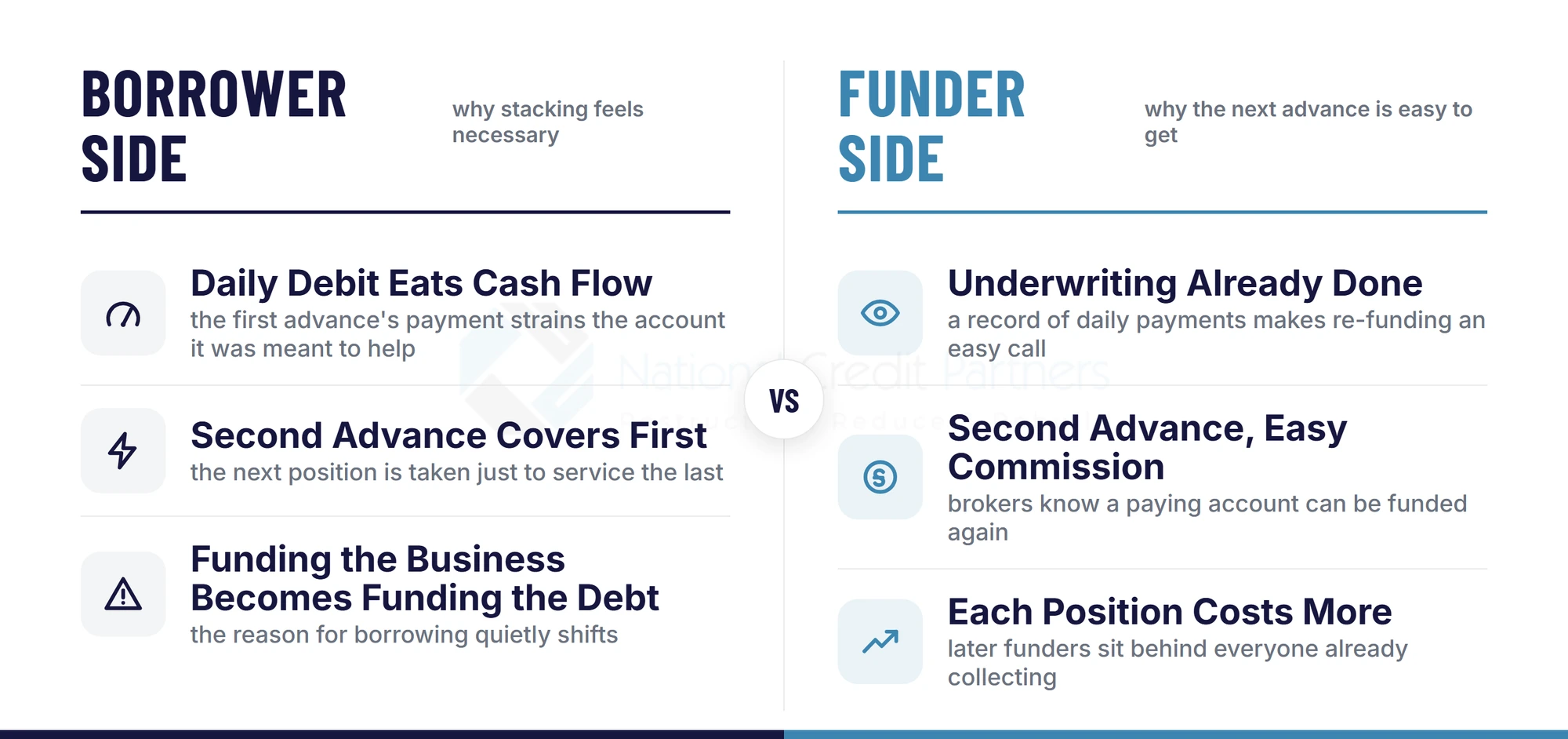
Almost no one sets out to stack. The first advance covers a real gap, a slow season, a delayed receivable, an unexpected bill, and it does its job. Then the daily debit itself starts eating the cash flow the business needs to operate, so a second advance goes toward covering the first. From there the pattern is self-feeding: each new position is taken to service the last, and the reason for borrowing quietly shifts from funding the business to funding the debt.
The supply side pushes in the same direction. Once you have one advance and a record of daily payments, brokers know you can be funded again, and a second advance is an easy commission with a repayment history already in place. Some funders openly advertise taking second, third, and fourth positions precisely because someone else has already done the underwriting. Many first-position agreements formally prohibit stacking, but that language protects the funder's priority, not the borrower's solvency, and it rarely stops a later funder from advancing anyway.
The result is a market where the person under the most pressure is offered the most expensive money, on the day they are least able to judge it. Each new position also tends to carry a higher factor rate than the one before, because the later funder is taking a worse position behind everyone already collecting.

The danger of stacking is not really the total balance. It is the daily withdrawal. The numbers below are illustrative, chosen as round figures to show how the arithmetic compounds, not drawn from any specific business. Take a company doing $15,000 a day in sales that ends up with three advances layered on one account:
That is $4,300 leaving the account every business day before a single employee, supplier, or utility bill is paid, on sales of $15,000. Roughly 29 cents of every dollar the business takes in is gone to debt service the moment it lands. On a five-day week that is more than $21,000 a week, and the three balances still owed total over $281,000 against $200,000 actually advanced.
Now stress it the way real businesses get stressed. A slow week drops sales to $11,000 a day while the debits stay fixed, because MCA payments do not fall when your revenue does unless a reconciliation clause is honored. Payroll, rent, and inventory are competing for what is left, and there may not be enough to cover the next morning's debits. Miss one, and the account can go negative, which trips default language across the other positions at the same time. Three funders each pulling from the same account is the pattern behind most businesses in genuine MCA crisis, and it is why the situation can look survivable on paper right up until the account cannot fund the day.
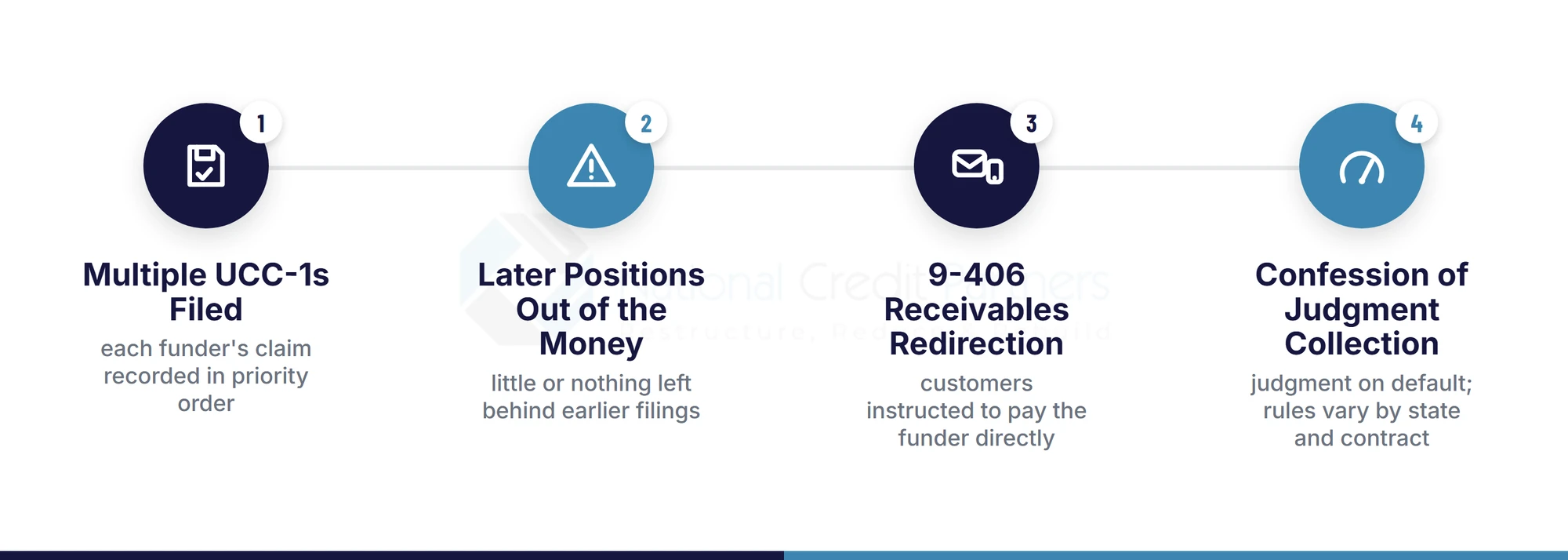
When stacked advances default, the consequences arrive from several directions at once, because each funder acts on its own contract. Understanding the sequence matters, because it is also what determines your leverage in a workout.
Multiple UCC-1 liens. Most funders file a UCC-1 financing statement when they advance, publicly claiming an interest in your receivables and, often, your other assets. With stacked positions you have several UCC-1 filings recorded in priority order. Later funders sit behind earlier ones, so in any recovery they are frequently what the industry calls out of the money, with little or nothing left for them if the business is liquidated.
Receivables redirection under UCC Article 9. A funder claiming your future receivables may attempt to notify the businesses that owe you money and direct those account debtors to pay the funder instead, a mechanism that flows from UCC 9-406. When that happens the money is intercepted before it ever reaches your account. For a business already short on daily cash, having a customer's payment diverted can be the blow that ends operations.
Confession of judgment and collection. Many MCA contracts historically included a confession of judgment, a clause the owner signs at the outset that lets the funder enter a court judgment on default without first suing or notifying you. New York, the jurisdiction most MCA contracts choose, changed its law in August 2019 so that a confession of judgment can no longer be filed there against a business that is not a New York resident. For out-of-state borrowers a funder now generally has to file a complaint, serve you, and litigate, and then collect on any judgment in your own state. That is slower and more expensive for the funder, which is exactly why it improves your position in a negotiation. None of this is legal advice, and confession-of-judgment rules vary by state and contract, so the specifics of your agreement need a professional read.
The compounding problem is that stacked positions do not escalate politely one at a time. A single missed morning can put you in default with several funders simultaneously, and each may move to protect itself before the others do. Waiting rarely makes any of this cheaper. We walk through what continued inaction actually costs in our piece on the cost of doing nothing about business debt.
The exit from stacked MCA debt is not another advance. Borrowing again to cover the daily debits is the same move that built the stack, and it shortens the time to default rather than extending it. The realistic way out treats the whole stack as one problem and renegotiates the positions together.
The leverage is real, even when it does not feel that way. A later-position funder that is out of the money knows it would collect little in a liquidation, and most MCA funders would rather keep a paying business alive on modified terms than push it under and recover pennies. Relief usually comes in two forms. In the short term, the daily or weekly debit is reduced to an amount the business can actually sustain, which stops the account from going negative and buys room to operate. Over the longer term, the outstanding balances are renegotiated into modified terms the business can carry to completion.
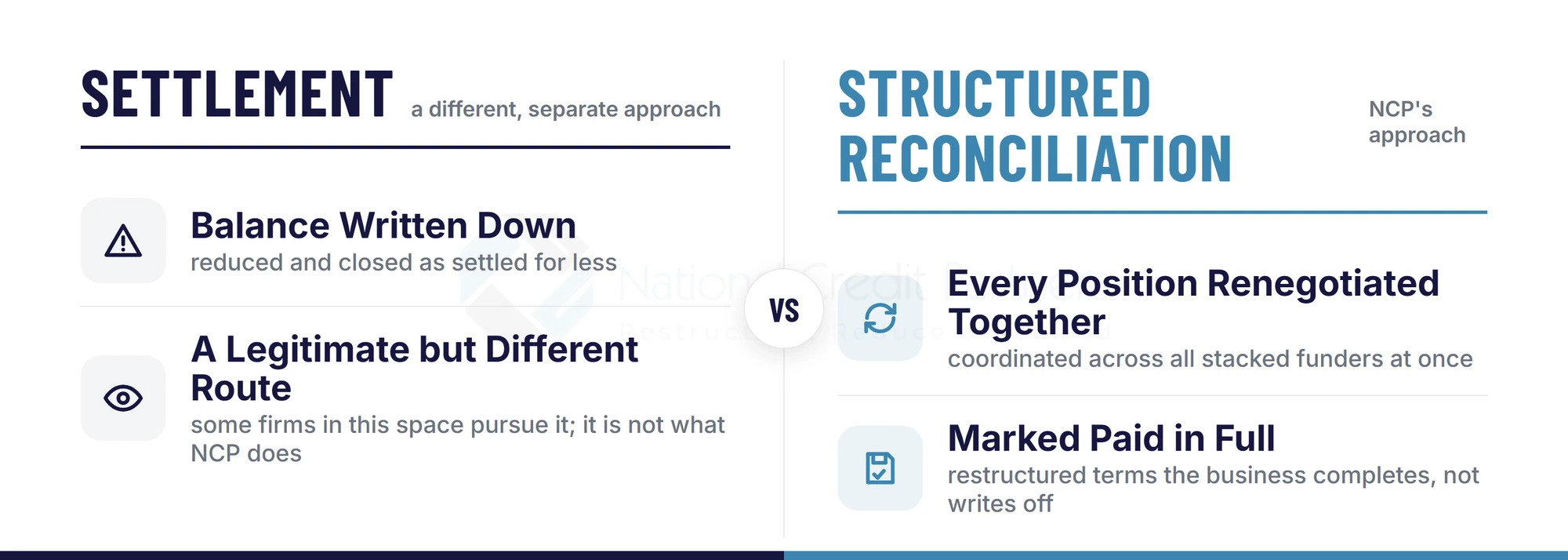
This is the approach National Credit Partners takes, which we call structured reconciliation: rather than fighting each funder in isolation, we coordinate the negotiation across every stacked position and work to replace unaffordable advances with restructured terms the business pays off and has marked paid in full. That paid-in-full outcome is deliberately different from a settlement, where a balance is written down and closed as settled for less. Some firms in this space pursue settlement; that is a legitimate route, but it is a different one, and it is not what we do. Our focus is a single, workable payment structure that clears the debt in full and keeps the business trading.
What that requires from you is early, honest information: every position, every daily amount, every contract, before the account fails rather than after. The earlier a stacked situation is addressed, the more of these levers are still available.
What is an MCA debt collector?
It is whoever is pursuing repayment of a merchant cash advance. Often it is the funder itself, since MCA debits are automatic ACH pulls from your account rather than invoices sent by a collections agency. When an advance defaults, the funder may escalate to a third-party collector, a law firm, or a judgment, and with stacked advances several funders can be pursuing you at the same time, each on its own contract.
Is a merchant cash advance illegal?
No. Merchant cash advances are legal in the United States and are generally written as a purchase of future receivables rather than a loan, which is how they sit outside most state usury caps. Some contract practices have drawn scrutiny, and courts in several states have been willing to reclassify particular MCAs as loans when the facts show they operate as loans. A growing number of states also now require commercial-financing disclosures. Legal does not mean cheap or safe, though: many advances carry effective annualized costs well above 100 percent.
How do you reduce MCA debt?
By renegotiating terms, not by borrowing more. In practice that means reducing the daily or weekly debit to a sustainable amount in the short term and restructuring the outstanding balances into terms the business can actually complete over the longer term. With stacked advances, the reduction has to be coordinated across every position at once, because lowering one debit while the others stay fixed does not solve the daily drain.
How can I get out of MCA debt?
Stop stacking, map the full picture, and address every position together. Taking a new advance to cover the old ones deepens the problem. The workable path is to lay out all positions, daily amounts, and contracts, then negotiate reduced payments and restructured balances across the whole stack, ideally before a missed debit puts you in default with several funders simultaneously. Acting early preserves the most leverage.
Why is stacking more dangerous than a single advance?
Because the daily withdrawals add up faster than the balances do. Each new position brings its own daily debit and usually a higher factor rate, so a business can be paying a crippling share of daily sales to debt service long before any single advance is close to paid off. A single missed morning can also trigger default across several positions at once, which is why stacking is the pattern behind most MCA-driven business failures.
Stacking rarely looks like a decision. It looks like a series of reasonable responses to real pressure, each one narrowing the room to maneuver a little further, until the daily debits are deciding whether the business makes payroll. The point worth holding onto is that the trap is built out of daily arithmetic, and arithmetic can be renegotiated. The businesses that recover are almost never the ones that found one more advance. They are the ones that stopped adding positions, put the whole stack on the table, and dealt with it as a single problem while there was still leverage left to use.
An A+ rating represents BBB's high degree of confidence that the business is operating in a trustworthy manner and will make a good faith effort to resolve any customer concerns filed with the BBB.