

MCA debt is the balance a business owes on a merchant cash advance, a financing arrangement that is legally a purchase of your future revenue rather than a loan, and priced with a factor rate instead of an interest rate. That structure is why the debt is expensive, why daily withdrawals hurt cash flow, and why the fastest way out is renegotiating the terms rather than waiting for the balance to run down on its own.
MCA debt is the outstanding balance a business owes on a merchant cash advance (MCA). A funder gives you a lump sum up front, and in exchange it holds the legal right to collect a fixed total, more than you received, out of your future revenue. The MCA debt is that total repayment obligation, minus whatever has already been pulled from your account.
The phrase trips people up because an MCA does not behave like a credit card balance or a term loan. There is no interest accruing on a declining balance. There is a fixed number you agreed to repay, and a mechanism, usually a daily or weekly automatic withdrawal, that keeps collecting until that number is reached. Understanding how that number is set, and how it gets collected, is the whole story of why MCA debt becomes a crisis for so many owners.
This is the most important thing to grasp, and the thing most MCA salespeople gloss over. A merchant cash advance is not legally a loan. It is structured as the purchase of your future receivables. The funder is buying a slice of the money your business has not yet earned, at a discount, and collecting it as that revenue comes in.
That classification is deliberate, and it has real consequences. Loans are governed by state usury laws that cap how much interest a lender can charge. A receivables purchase is treated as a commercial transaction, not a loan, so those interest caps generally do not apply. This is the legal reason MCA pricing can translate to effective annual rates that would be illegal on an actual loan in most states. The structure is not an accident; it is what lets the product exist at the cost it does.
It also separates a true MCA from traditional invoice factoring, which people sometimes confuse it with. In factoring, you sell specific, already-issued invoices and the factor collects those exact invoices from your customers. An MCA is broader: it takes a percentage of general future sales, whether those sales exist yet or not. For a fuller breakdown of how the product is marketed versus how it actually works, see our guide on the real truth about merchant cash advances.
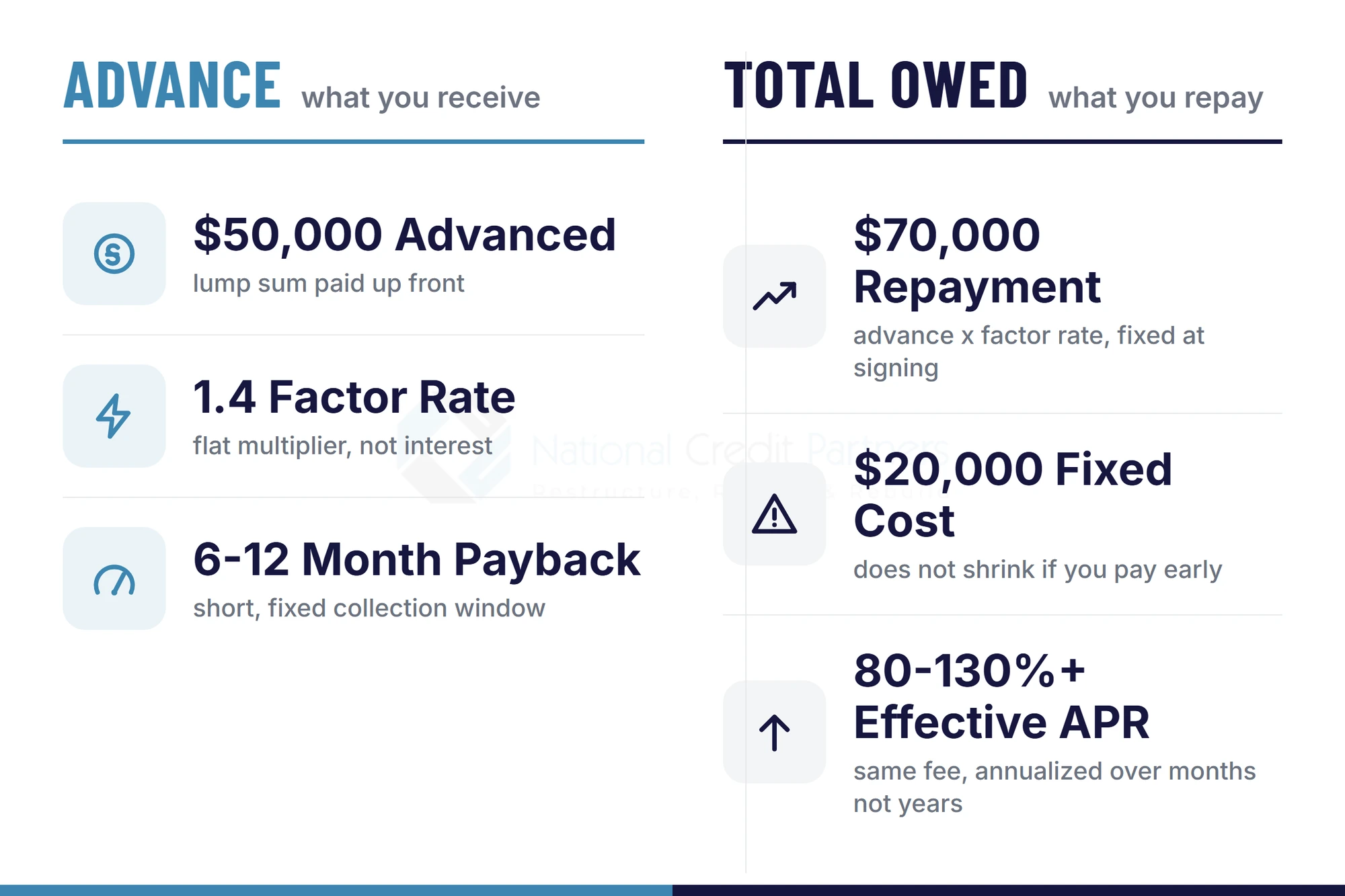
Because an MCA is not a loan, it does not use an interest rate. It uses a factor rate, a flat decimal multiplier applied to the amount advanced. Factor rates typically run from 1.1 to 1.5. You multiply the advance by the factor rate to get your total repayment. That total, not the amount you received, is the debt you have to clear.
Here is a worked example using round numbers for illustration only; these are not real client figures. Suppose a business takes a $50,000 advance at a factor rate of 1.4. The total repayment is $50,000 x 1.4 = $70,000. The $20,000 gap is the cost of the advance, and it is fixed the moment you sign. It does not shrink if you pay early. On a loan, repaying faster saves you interest; on an MCA, you owe the same $20,000 whether it takes you five months or eleven.
The reason that fixed cost feels so brutal is the short payback window. That same $70,000 is often collected across just six to twelve months. Translate a flat $20,000 fee on $50,000, collected in half a year, into the annualized terms a bank would quote, and the effective APR lands in the range of roughly 80 to 130 percent, depending on how fast the money is pulled. That is not a typo. Independent lending analysts put effective MCA APRs anywhere from about 40 percent to 350 percent, several times higher than a bank line of credit and many times higher than an SBA loan. The factor-rate label hides that number, which is exactly why so many owners do not see the true cost until the daily withdrawals start.
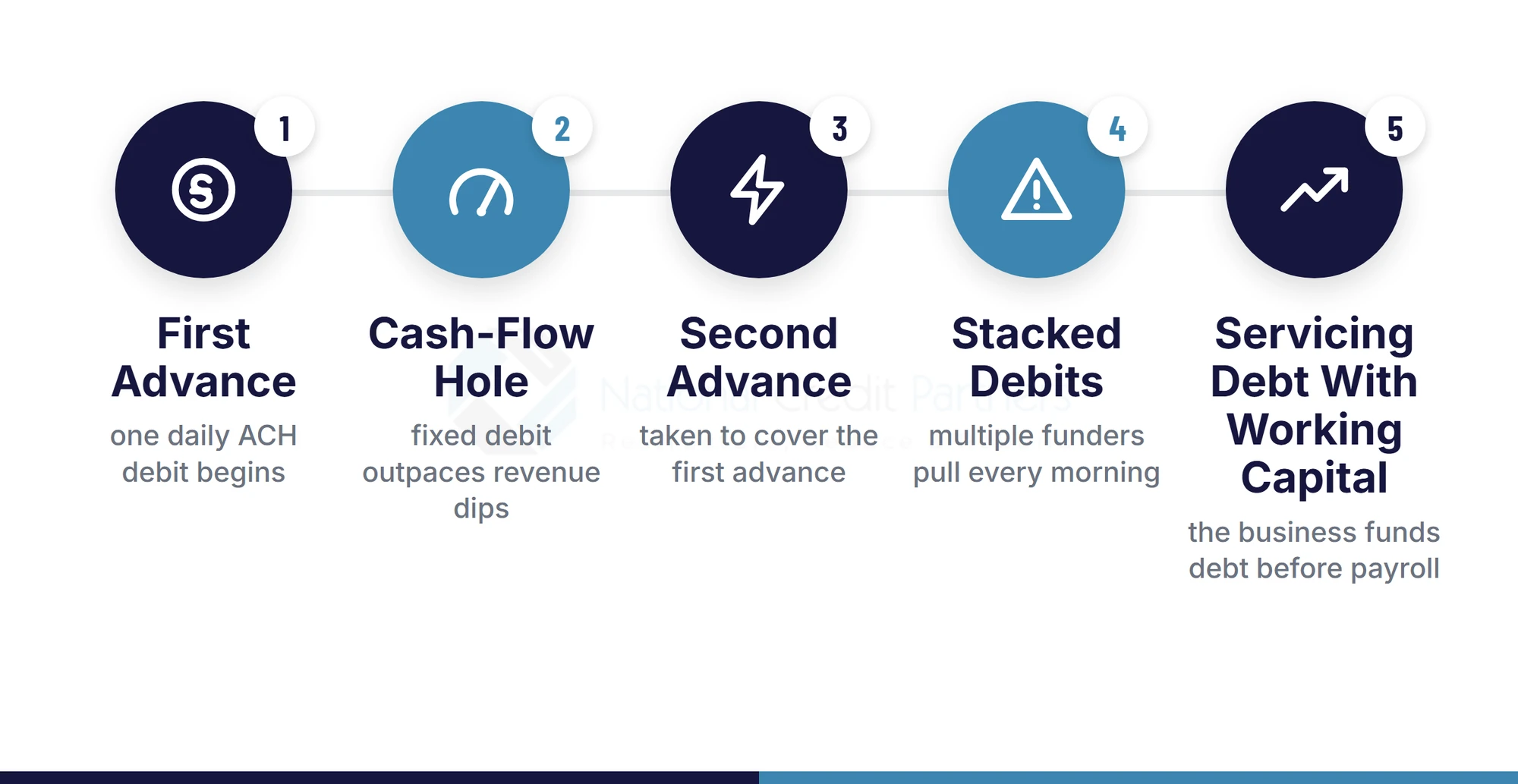
MCA debt is repaid through automatic ACH withdrawals from your business bank account, usually every business day. Take the $70,000 repayment above, collected over roughly 200 business days, and the funder pulls about $350 every weekday, Monday through Friday, regardless of whether yesterday was your best day of the month or your worst.
Some contracts include a reconciliation clause that is supposed to flex the payment down when your revenue dips. In practice, funders often resist honoring it, and the fixed daily debit keeps hitting whether business is good or not. That rigidity is manageable with one advance and a healthy margin. It stops being manageable the moment an owner takes a second.
That pattern, taking a new advance to cover payments on an existing one, is called stacking, and it is the single most common route into serious MCA debt. Owners rarely stack out of carelessness. They stack because the first advance's daily pull created a cash-flow hole, and a second advance looks like the fastest way to plug it. Now two, three, or four funders are each pulling from the same account every morning. Combined daily debits of $2,000 or $3,000 leave the account before payroll, rent, or a single supplier gets paid. The advances have not compounded in the interest sense, but the daily drain has stacked, and the effect on operating cash is the same: the business is servicing debt with money it needs to run. If you are watching this happen and doing the math on what waiting costs, we have modeled it in detail in our piece on the real cost of doing nothing about business debt.
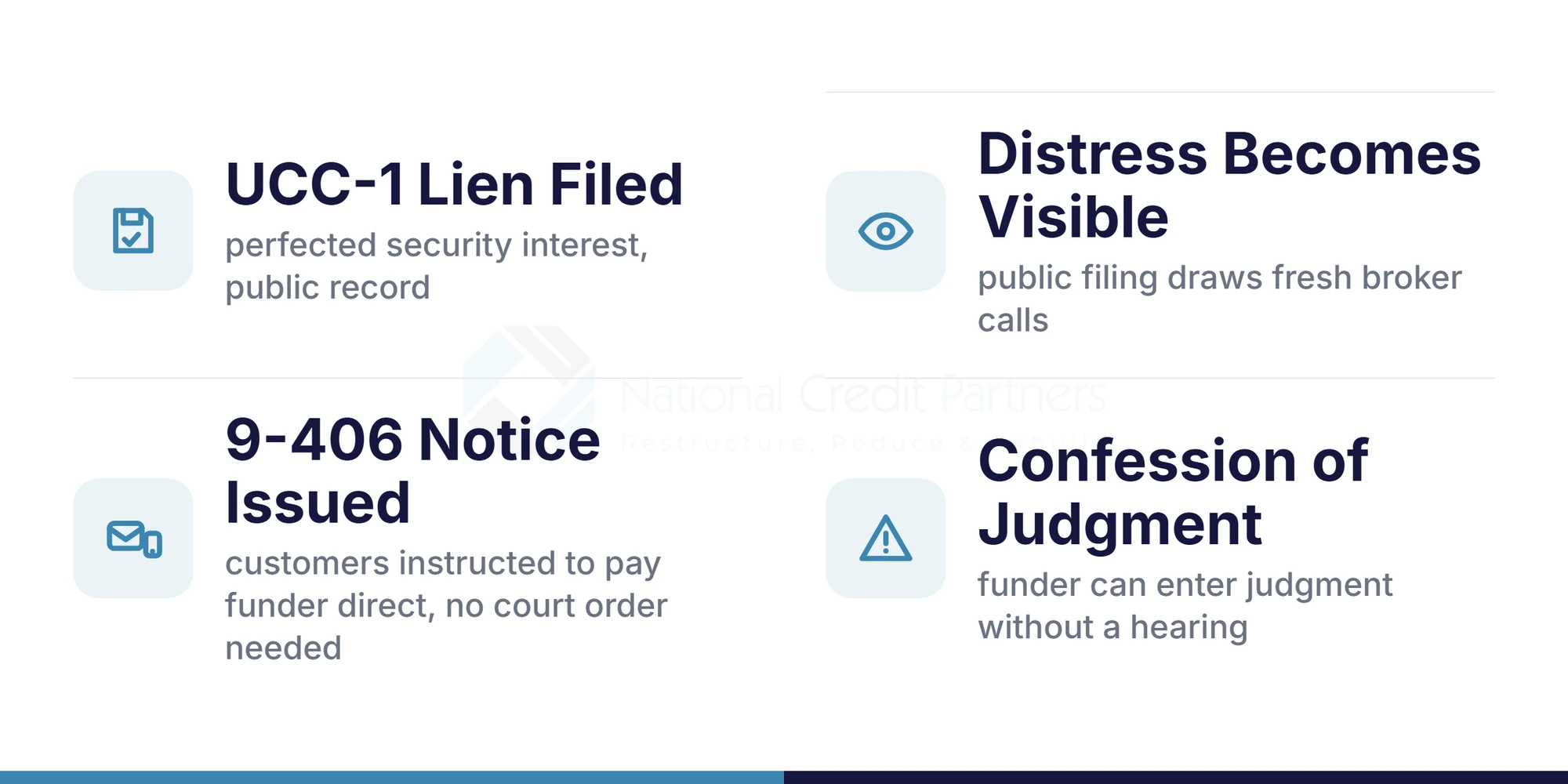
What makes MCA debt genuinely dangerous, more so than the cost alone, is the legal machinery attached to it. Most funders secure the advance by filing a UCC-1 financing statement against your business under Article 9 of the Uniform Commercial Code. That filing gives them a perfected security interest in your receivables and often your other business assets. It is public record, and it is why brokers start calling with fresh offers once you have a lien on file; your distress is now visible.
The sharpest tool that lien unlocks is a notice under UCC Section 9-406. In plain terms, once a funder has a security interest in your receivables and you are in default, 9-406 lets it notify the customers who owe your business money and instruct them to pay the funder directly instead of you. Your incoming revenue is intercepted at the source. No court order is required to send the notice; it is a right the funder already holds under Article 9 and the contract you signed. For a business whose customers are suddenly told to redirect payment, cash flow can collapse within days even though the underlying business is perfectly healthy. If you want the primary source, the statutory text lives in Article 9 of the UCC, hosted publicly by Cornell Law School's Legal Information Institute.
Many MCA contracts also carry a Confession of Judgment (COJ). By signing one, an owner waives the right to contest the debt in court. On default, the funder can enter a judgment without a hearing and move to freeze accounts or seize assets. Between the UCC-1 lien, a 9-406 redirection notice, and a COJ, an MCA funder can exert pressure that most traditional creditors simply cannot, and it can do most of it without ever going before a judge.
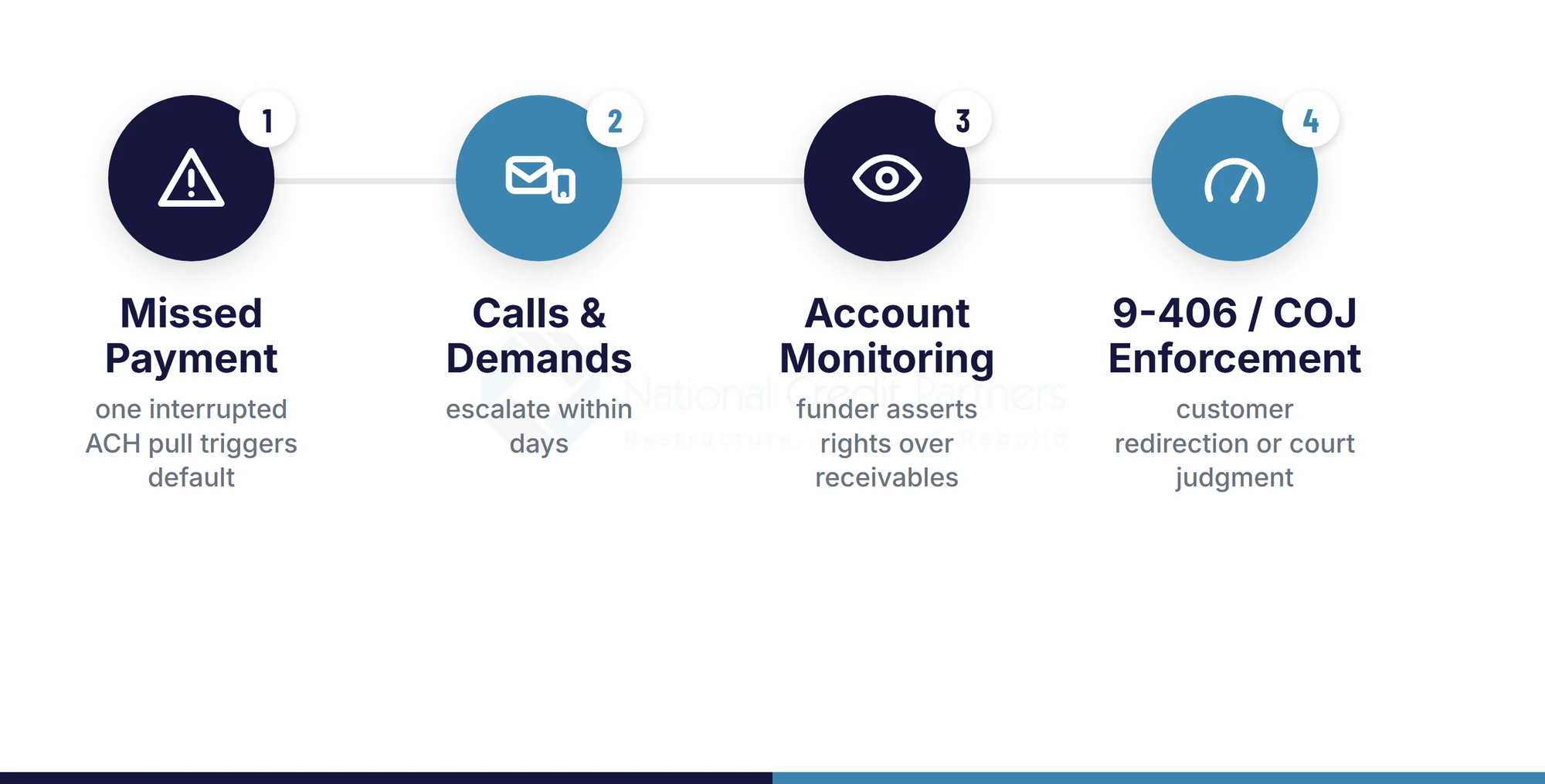
Missing an MCA payment is treated as a breach of the purchase agreement, and because the debt is not a loan, default can be declared fast, sometimes over a single interrupted ACH pull or a bank-account change the funder was not told about. The escalation that follows tends to move quickly: repeated calls and demands within days, then account monitoring and assertion of the funder's rights over your receivables, and in serious cases, 9-406 notices to your customers or COJ enforcement.
The costly myth is that simply stopping payments saves money. It rarely does. Unmanaged default usually raises the total cost through legal exposure, hardened funder positions, and emergency decisions made under pressure, and it strips away the negotiating leverage you had while still current. Silence is often the worst move of all, because funders read it as bad faith and accelerate enforcement. We break down the real timeline and the exaggerated-versus-genuine risks in our guide on MCA default risks and what really happens if you stop paying. The short version: default itself is not what destroys businesses; a disorganized, unadvised response to it is.
No, merchant cash advances are not illegal. They occupy a lightly regulated corner of business finance precisely because they are structured as receivables purchases rather than loans, which places them outside most federal and state lending rules, including the usury caps that limit loan interest. That is not the same as being unregulated in every respect, and several states have introduced commercial-financing disclosure requirements. But as a category, MCAs are a legal product.
The legality of the product does not mean every provider behaves well, or that every contract term is enforceable. Because the space attracts aggressive actors and confusing contracts, some individual practices, continuing to withdraw funds after ACH authorization has been properly revoked in writing, for instance, can cross legal lines even when the advance itself is valid. The advance being legal and the collection conduct being lawful are two separate questions.
Once you see MCA debt for what it is, a fixed obligation with a punishing collection schedule and serious legal teeth, the way out becomes clearer. You cannot out-earn a daily debit that is larger than your margin, and waiting only lets the enforcement clock run. What changes the equation is renegotiating the terms of the debt itself: the daily amount, the timeline, and the pressure attached to it.
There are several routes across the landscape, and it helps to know them apart. Consolidation replaces multiple advances with one new loan, but it needs credit and cash flow you may no longer have. Settlement means negotiating to pay less than the full balance, which can reduce the number owed but is the other approach, the one where the debt is marked settled for less rather than paid in full, and it can invite an aggressive response and complicate future lender relationships. Bankruptcy is a last resort for businesses that can no longer operate.
The approach National Credit Partners uses is structured reconciliation: negotiating directly with each funder to replace unaffordable terms with modified ones your cash flow can actually support, with the goal of having resolved advances marked paid in full rather than settled for less. It works because it aligns with what a rational funder actually wants. A funder facing an owner who is about to default, or fold, generally recovers more by agreeing to a workable schedule than by forcing a collapse and chasing whatever is left through liens and lawsuits. Reconciliation gives both sides a cleaner outcome: the business keeps operating and the debt gets repaid on terms that hold. That is the leverage a structured negotiation is built on, and it is strongest before default, while you still have options open.
If your business is carrying $50,000 or more in MCA debt and the daily withdrawals are outrunning what you bring in, the most useful next step is a clear-eyed assessment of where you actually stand and which routes are still open to you. National Credit Partners offers a free, no-obligation consultation to review your advances and explain your structured reconciliation options, so you can decide from information rather than pressure.
MCA debt is confusing by design. The factor rate hides the true cost, the daily withdrawal masks how fast the balance is really draining your business, and the legal clauses stay quiet until the moment you fall behind. But none of it is mysterious once you name it: a receivables purchase, priced by a flat multiplier, collected daily, and backed by UCC liens. Owners who understand those mechanics stop asking whether they can wait it out and start asking the better question, how do I get these terms changed before the enforcement machinery turns on. That shift, from waiting to acting while options are still open, is almost always what separates the businesses that come through MCA debt intact from the ones that do not.
What is MCA debt?
MCA debt is the balance a business owes on a merchant cash advance. A funder advances a lump sum up front in exchange for the right to collect a larger fixed total out of the business's future revenue, usually through daily or weekly automatic withdrawals. The debt is that total repayment obligation, and because an MCA is legally a purchase of future receivables rather than a loan, it is priced with a factor rate instead of an interest rate.
What does MCA mean in loans?
MCA stands for merchant cash advance. Strictly speaking it is not a loan at all. It is structured as the purchase of a business's future receivables, which is why it uses a factor rate rather than an interest rate and why it falls outside most state usury laws that cap loan interest. People call it an MCA loan casually, but the legal classification as a receivables purchase is what defines how it works and how it is enforced.
How is MCA debt calculated?
MCA debt is calculated by multiplying the advance amount by a factor rate, typically between 1.1 and 1.5. For example, a $50,000 advance at a factor rate of 1.4 creates a total repayment of $70,000. The $20,000 difference is the fixed cost of the advance and does not shrink if you repay early. Because that fixed cost is often collected over just six to twelve months, the effective annual cost can run well into the triple digits.
What happens if you don't pay MCA?
Missing MCA payments is treated as a breach of contract, and default can be declared quickly. Funders typically escalate with repeated collection contact, then assert their rights over your receivables through the UCC-1 lien they filed. In serious cases they can send UCC 9-406 notices instructing your customers to pay them directly, or enforce a Confession of Judgment to obtain a court judgment without a hearing. Simply stopping payments without a strategy usually increases the total cost and reduces your negotiating leverage.
Are MCA loans illegal?
No, merchant cash advances are not illegal. They are a legal financing product, structured as receivables purchases, which places them outside most lending regulations, including usury caps. However, the product being legal does not make every provider's conduct lawful. Practices such as continuing to withdraw funds after ACH authorization has been properly revoked in writing can cross legal lines even when the advance itself is valid.
What is MCA stacking?
Stacking is taking a second, third, or additional merchant cash advance while an earlier one is still active, most often to cover the payments on the existing advance. Each new advance adds another daily withdrawal and another UCC lien. Combined daily debits from multiple funders can quickly exceed a business's operating margin, which is why stacking is the most common path into a serious MCA debt crisis.
How do you get out of MCA debt?
The most effective way out of MCA debt is renegotiating the terms rather than trying to out-earn the daily withdrawals. Options across the landscape include consolidation, settlement, and, as a last resort, bankruptcy. National Credit Partners uses structured reconciliation: negotiating directly with each funder to replace unaffordable terms with a schedule the business can meet, aiming to have resolved advances marked paid in full. This works best before default, while negotiating leverage is still intact.
An A+ rating represents BBB's high degree of confidence that the business is operating in a trustworthy manner and will make a good faith effort to resolve any customer concerns filed with the BBB.