

Debt management strategies for companies fall into two groups: routine tactics for debt you can still service, and recovery tactics for debt that is outrunning your cash flow. This guide covers both, from mapping every obligation and prioritizing by cost and risk to fixing cash flow, weighing refinancing against consolidation, and negotiating modified terms, and explains when a distressed business, especially one buried in stacked merchant cash advances, needs structured reconciliation rather than another repayment schedule.
On this page
Most advice about managing business debt assumes you are still in control of it: choosing between the avalanche and snowball methods, tightening a budget, deciding whether consolidation makes sense. That advice is sound when your debt is a manageable line on the balance sheet. It is close to useless when your business is being drained by daily or weekly payments it can no longer cover. The strategies that actually work depend entirely on which of those two situations you are in.
A company with healthy margins and a couple of term loans has a scheduling problem. It can reorder its payments, refinance to a lower rate, and be measurably better off in a few months. A company facing several merchant cash advances pulling from its account every morning has a solvency problem, and no repayment schedule fixes that. Treating the second situation like the first is how good businesses run out of road. This guide works through the strategies for both, in the order a business under pressure should apply them, and is written for the owner who is already carrying more debt than the business can comfortably service.
You cannot manage debt you have not fully counted, and under pressure it is easy to track only the payments that hurt most this week. Before you decide on any strategy, build a single, complete list of every obligation the business carries. For each one, record the creditor, the outstanding balance, the cost of the money, the payment amount and frequency, any collateral pledged, and whether you signed a personal guarantee or a confession of judgment.
For a distressed business, the payment frequency column is the one that tells the real story. A monthly term-loan payment and a daily ACH debit of the same annual size are not the same problem; the daily debit strips your operating cash before you can put it to work. Note which debts are secured and by what. Merchant cash advances and many unsecured business loans are backed by a UCC-1 filing against your receivables, and that filing shapes what you can and cannot do next. This map is not busywork. It is the difference between a strategy aimed at your actual situation and a generic checklist aimed at nobody.
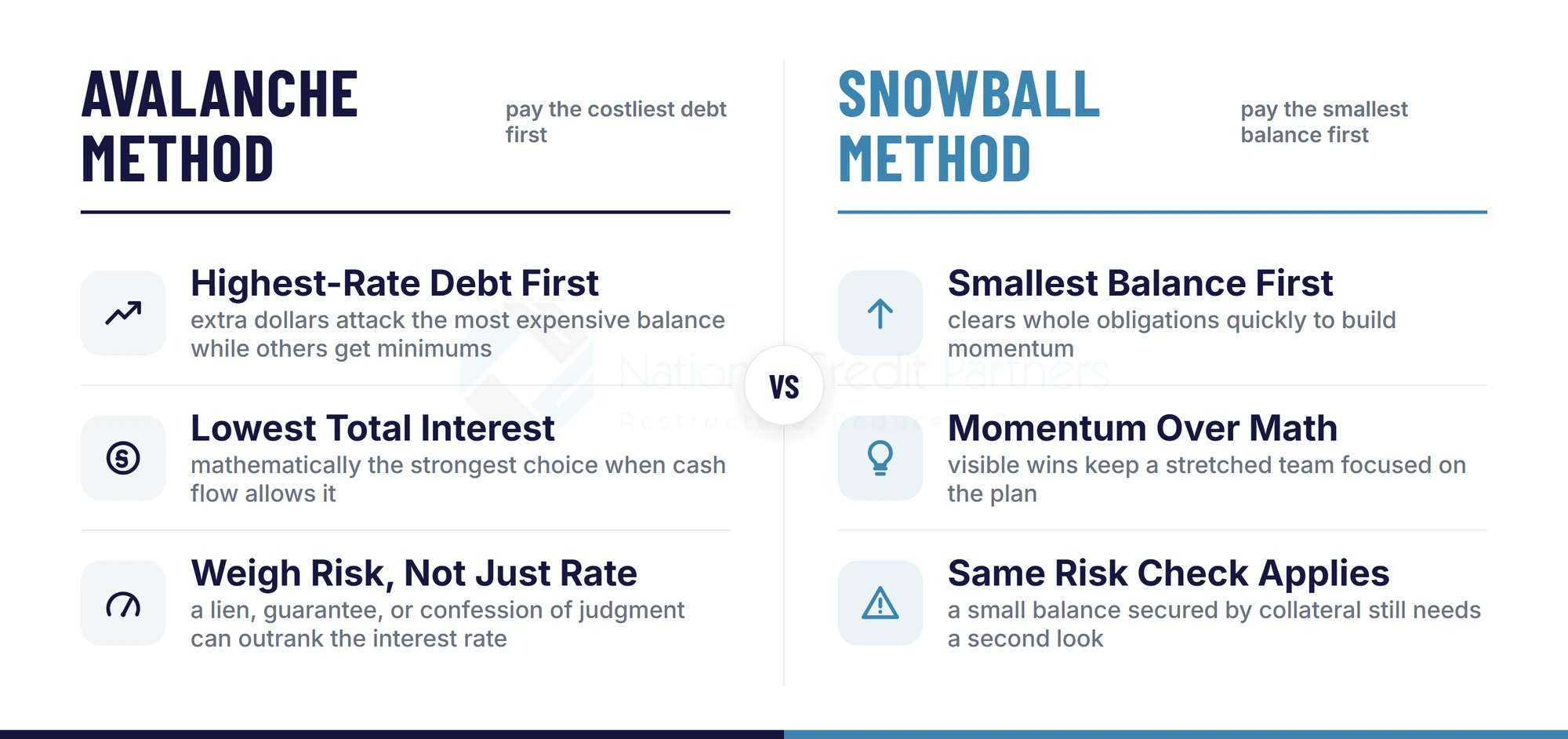
The two repayment methods you will see recommended everywhere are the avalanche and the snowball. The avalanche method directs every spare dollar at the highest-rate debt first while you make minimums on the rest, which saves the most in interest. The snowball method attacks the smallest balance first to clear whole obligations quickly and build momentum. Both are legitimate, and for a business with room to breathe, the avalanche is usually the mathematically stronger choice.
But a company carrying too much debt has to add a second axis these methods ignore: risk. Rate alone does not capture which creditor can hurt you fastest. A debt secured by a blanket lien on your receivables, or one backed by a personal guarantee or a confession of judgment, carries enforcement risk that an unsecured trade balance does not, even if the trade balance has a higher stated rate. Merchant cash advances make this starker still, because their true cost is expressed as a factor rate rather than an interest rate, which can translate to an effective annualized cost far above what the number on the contract suggests. Prioritize by asking two questions of every debt at once: what is it really costing me, and what can this creditor do to me if I miss a payment. The debt that scores worst on both is where your attention belongs.
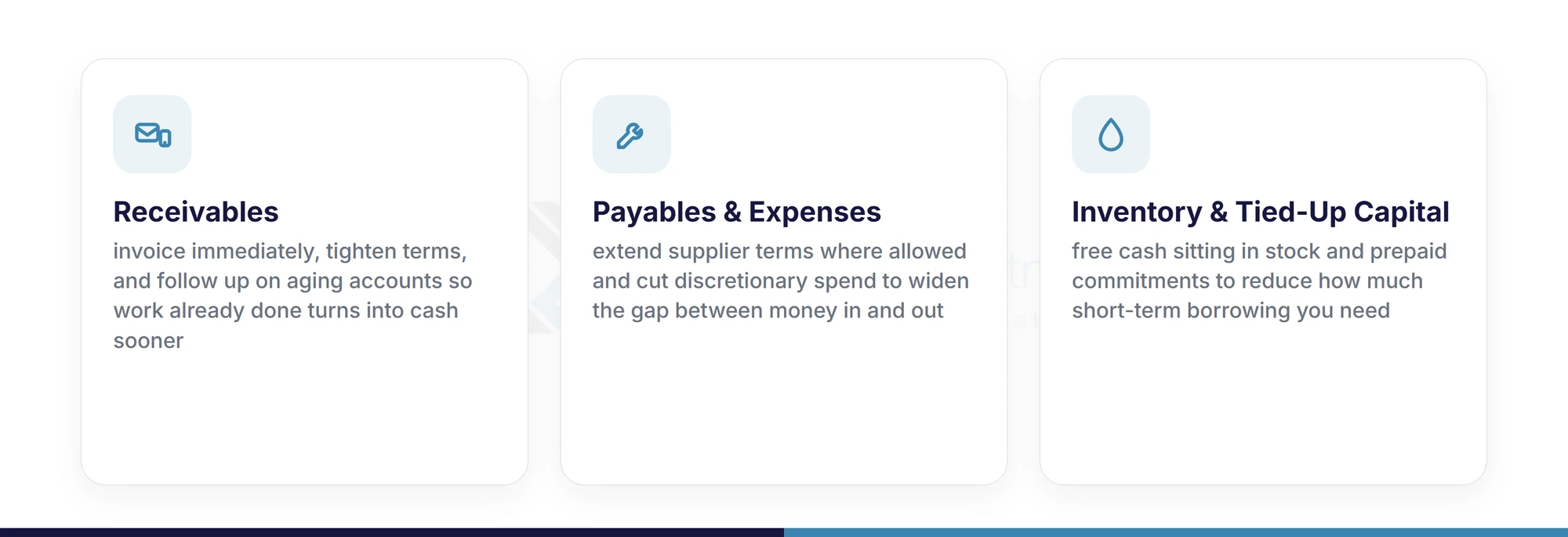
Debt is often the symptom, and a cash flow gap is the disease. If money leaves the business faster than it comes in, no repayment strategy holds, because you will keep borrowing to cover the shortfall. Before or alongside any restructuring, work the three levers that move operating cash.
None of this is glamorous, and none of it clears a large debt on its own. What it does is buy room, and room is what lets every other strategy on this page work. A business that has closed its cash flow gap can negotiate from a position of relative strength. A business still bleeding cash every week is negotiating with a gun to its head, and creditors can tell.
Refinancing replaces an existing debt with a new one on better terms, usually a lower rate or a longer term that reduces the monthly payment. Consolidation rolls several debts into one, so you make a single payment instead of many. Both can genuinely help a business that still qualifies for reasonable credit, because they lower the cost of the money and simplify the schedule. If your business is fundamentally sound and the problem is that your debt is expensive or scattered, this is often the cleanest fix available.
The trap is applying these tools to a business that no longer qualifies for good terms. When a distressed company cannot get a bank refinance, it is often steered toward a new advance marketed as a way to consolidate the old ones. In the merchant cash advance world this frequently means taking on another advance to pay down earlier advances, which does not reduce the debt so much as reshuffle and usually enlarge it. Refinancing only helps when the replacement money is genuinely cheaper and the business can service it. If the only credit you can access costs more than the debt it is meant to solve, consolidation is not a strategy, it is the next layer of the problem.
When a debt cannot be refinanced away, the next strategy is to change the terms of the debt you already have. Most creditors would rather collect on modified terms than push a business into default and chase whatever is left, so there is more room to negotiate than distressed owners assume. Restructuring alters an existing agreement, most often by lowering the payment, extending the term, or pausing collection while you stabilize. Unlike refinancing, it does not require you to qualify for new credit, which is why it remains available to businesses that banks have already turned down.
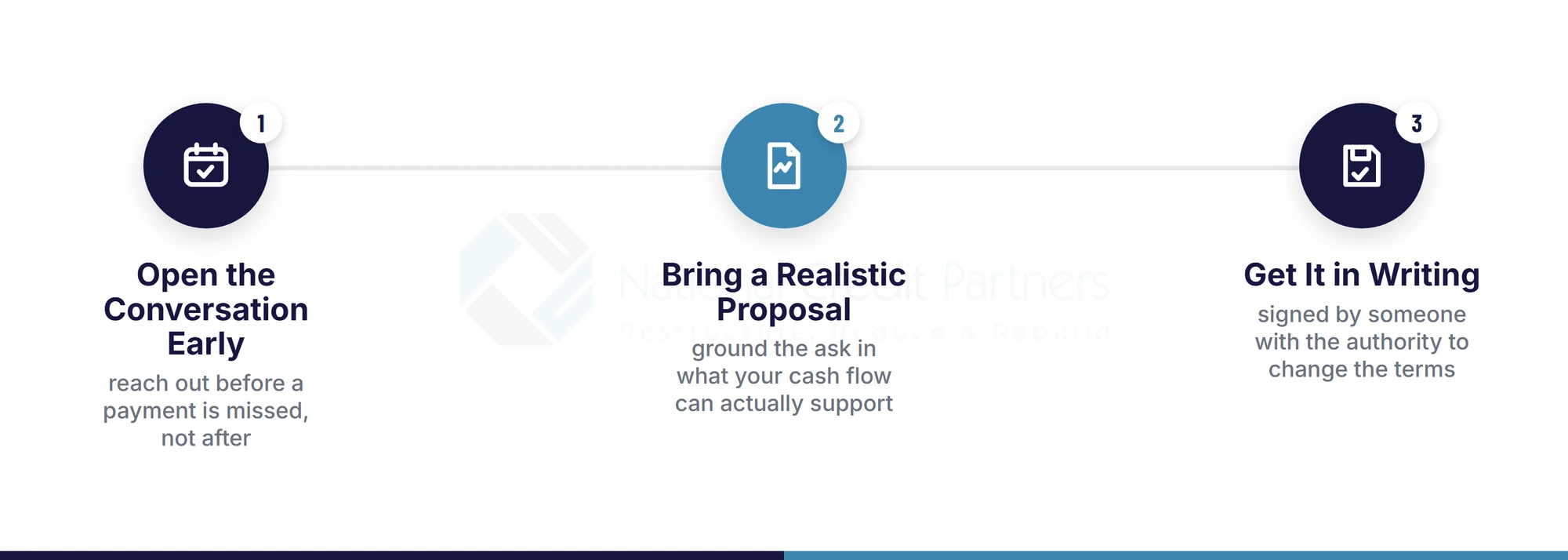
Approach it deliberately. Open the conversation before you miss a payment rather than after, come with a realistic proposal grounded in what your cash flow can actually support, and get any agreement in writing signed by someone with the authority to change the terms. The weakness of doing this yourself is leverage and information: you are negotiating one creditor at a time, often with the party pressing hardest, and you rarely know what terms that creditor has accepted from other businesses. That imbalance is exactly what turns a straightforward negotiation into a bad deal, and it is the point at which many owners bring in help.
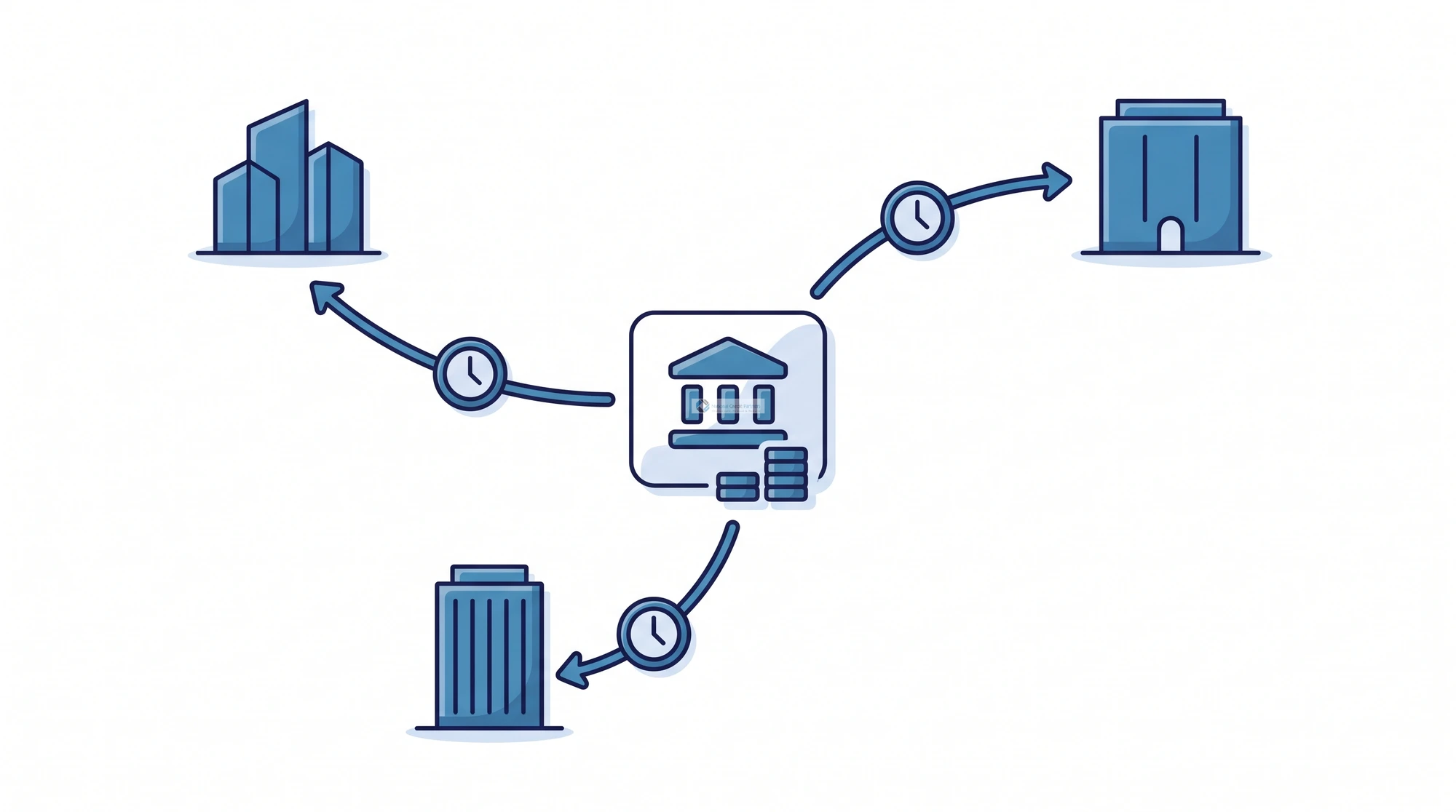
There is a point where the strategies above stop being enough, and it usually arrives with stacked merchant cash advances. Stacking is when a business has taken multiple advances at once, each pulling its own daily or weekly ACH debit from the same account, and each secured by its own UCC-1 lien on the same receivables. Once several funders are competing for the same incoming cash, the ordinary playbook breaks down. You cannot out-earn factor-rate money. You usually cannot refinance, because the blanket liens already filed against your assets block a new secured lender from stepping in. And negotiating with five funders one at a time, while all five keep debiting, is close to impossible to hold together.
This is the situation where a coordinated restructuring approach earns its place. Rather than fighting each advance separately, the debts are addressed together, with the funders engaged in parallel and the daily-debit pressure managed while modified terms are worked out. At National Credit Partners this is the work we do, and we call it structured reconciliation: negotiating directly with your funders to replace advances you cannot afford with terms your business can, aiming to have those advances marked paid in full rather than settled for less. That distinction matters, because an advance marked paid in full keeps you in cleaner standing than a balance recorded as settled. Where enforcement mechanics are already in play, this often runs alongside UCC Article 9 restructuring of the liens securing the debt. NCP holds an A+ rating with the Better Business Bureau, and typically works with businesses carrying $50,000 or more in stacked business debt, the range where handling it alone is hardest.
Not every business needs outside help, and it is worth being honest about where the line sits. If your debt is manageable, your cash flow is positive, and you simply want to pay it down faster, the strategies earlier on this page are enough; a professional adds little. Bring in help when the picture changes: when payments are eating cash you need for payroll, when you are borrowing to service existing debt, when multiple creditors are pressing at once, or when a default feels like a question of when rather than if.
At that stage the value of a specialist is leverage and coordination you cannot manufacture alone: engaging every creditor together, negotiating from a full picture of your obligations, and protecting your standing so future financing stays possible. If you want to see how a coordinated approach would apply to your specific debts, our business debt management plan lays out how the process works, and you can request a free, confidential consultation to talk through your situation with no obligation. The point of asking early is simple. The strategies in this guide all work better while you still have room to use them, and that room shrinks every week you wait.
The right debt management strategy is not a single method you pick off a list. It is a sequence that depends on how much pressure your business is actually under. Map everything you owe, prioritize by cost and by how fast each creditor can hurt you, and fix the cash flow gap underneath the debt. Where the business still qualifies, refinance or consolidate into cheaper, simpler terms. Where it does not, negotiate the terms of the debt you already have. And where stacked advances have taken the decision out of your hands, recognize that the problem is no longer a scheduling one and get coordinated help before a default forecloses your options. The businesses that come through debt intact are rarely the ones that found a clever trick. They are the ones that read their situation honestly and acted while they still had choices.

An A+ rating represents BBB's high degree of confidence that the business is operating in a trustworthy manner and will make a good faith effort to resolve any customer concerns filed with the BBB.