

Sign a New York confession of judgment and you hand your creditor a shortcut: the power to walk an affidavit into a county clerk's office and walk out with an enforceable judgment against your business, with no lawsuit, no hearing, and no chance for you to argue the debt. For a small business owner already stretched by a merchant cash advance or a stacked balance, that judgment can freeze bank accounts and seize receivables before you even know it exists. This page explains exactly how a confession of judgment works in New York under CPLR 3218, what the 2019 reform did and did not change, how long one stays enforceable, and what your realistic options are if one has been signed or filed against you.

A confession of judgment is a procedural device, not a lawsuit. The debtor signs a sworn affidavit admitting a specific amount is owed and authorizing the creditor to enter judgment for that amount if a condition is met, usually a default on payments. The creditor holds the signed affidavit, and if the debtor stops paying, files it with a county clerk to obtain an entered judgment directly. There is no summons, no complaint, and no opportunity to contest liability before the judgment lands. Once entered, a confessed judgment is enforced like any other New York money judgment, and it can be domesticated in other states to reach assets outside New York.
In commercial practice, COJs typically back a settlement agreement or a payment plan: the debtor signs one and it sits in escrow, released and filed only if the debtor breaks the deal. In business lending, and especially in merchant cash advance agreements, the COJ was often bundled into the funding contract itself, so a single missed ACH debit could convert into a judgment within hours. That speed, combined with the fact that the borrower has already waived the right to be heard, is what makes a confession of judgment such a powerful collection tool, and such a dangerous one to sign without understanding it. Our companion guide, what a UCC lien means for your business, covers how the lien side works nationally; this page focuses on the New York confession-of-judgment rules specifically.
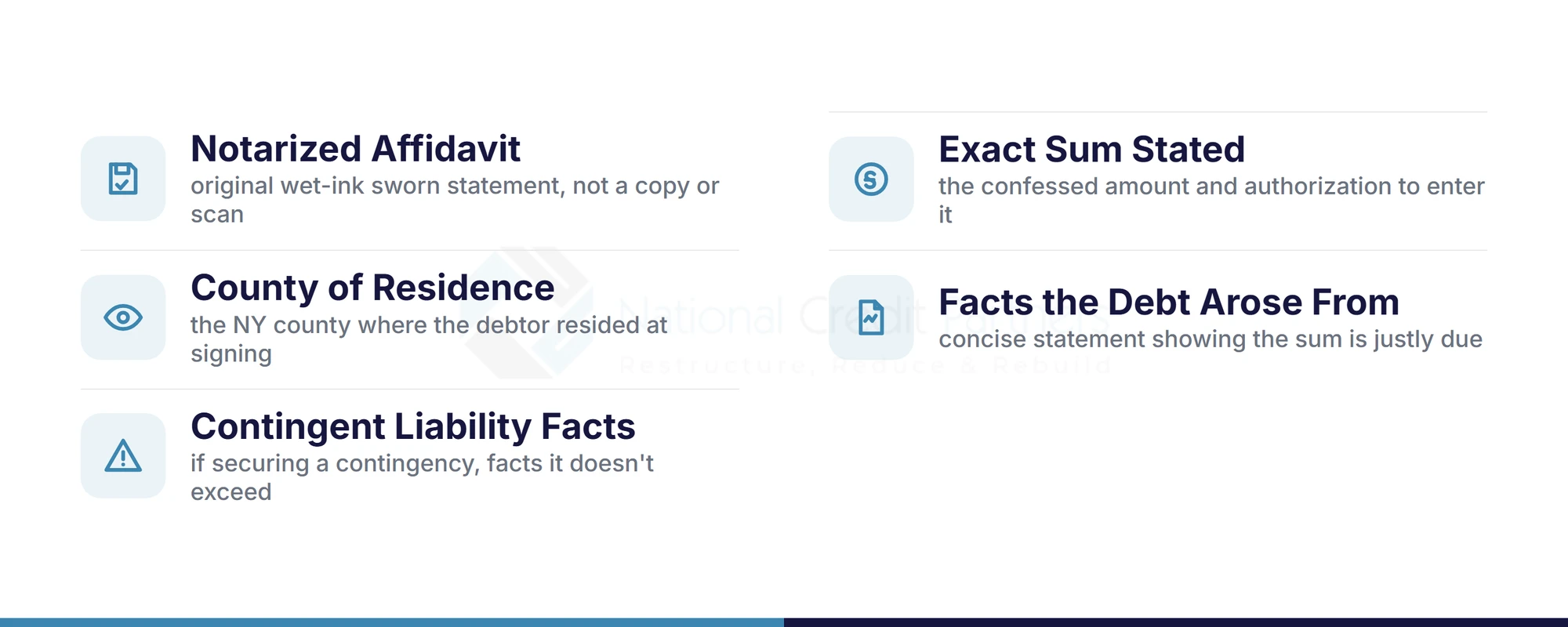
New York confessions of judgment are governed by Section 3218 of the Civil Practice Law and Rules (the CPLR). Under CPLR 3218(a), a judgment by confession may be entered without an action, either for money due or to become due, or to secure the creditor against a contingent liability, provided the debtor executes an affidavit that meets strict requirements. A defect in any of these requirements can be grounds to vacate the resulting judgment, because New York courts have held that a COJ must strictly comply with every provision of the statute.
The core statutory requirements are:
One point often misunderstood by debtors is who the specificity requirement protects. New York courts have repeatedly held that the requirement to state the facts "out of which the debt arose" exists to protect innocent third-party creditors who might be prejudiced by a collusive judgment, not to protect the person who signed the confession. In Balahtsis v. Shakola (Appellate Division, Second Department, 2021), the court refused to let a signer vacate a confessed judgment on the ground that the affidavit lacked specificity, holding he was foreclosed from raising a protection meant for third parties. A separate procedural device, CPLR 3219 (an offer to liquidate a claim by an offer to compromise), is sometimes confused with a confession of judgment but is a different mechanism entirely.

For years, out-of-state creditors, many of them MCA funders, exploited New York's fast COJ process by having small business owners across the country sign confessions of judgment and then filing them in New York county clerks' offices, against debtors who had no real connection to New York. The New York Legislature responded by amending CPLR 3218, and the change is what most people mean when they say New York "banned" confessions of judgment.
Effective 30 August 2019 (2019 N.Y. Senate Bill 6395), confessions of judgment executed on or after that date by parties who did not reside in New York at signing are no longer enforceable in the state's courts. The amended statute requires the affidavit to state the New York county in which the defendant resided when it was executed, and the confession may be filed only in that county, or, if the defendant later moved to a different county within New York, in the county where the defendant resided at the time of filing. The Legislature stated plainly that its purpose was "to remedy abuses in the use of confessions of judgment by creditors against out-of-state debtors."
Two details matter for businesses. First, a non-natural person, such as a corporation or LLC, is deemed to reside in any New York county where it has a place of business, not only where it is headquartered, so an entity with any New York location can still be subject to a New York COJ. Second, government agencies are exempted and may still file confessions against out-of-state parties. The reform narrowed abuse; it did not abolish the tool. New York courts have also shown they will police the residency rules strictly: in a 2024 Kings County Commercial Division decision, Porges v. Kleinman, a confession was vacated because the county caption had been altered to fix a venue problem, which the court held was not a permissible ministerial correction.
It is a mistake to read the 2019 reform as the end of New York confessions of judgment. The amendment removed the venue that out-of-state debtors were being dragged into; it left the tool fully intact for anyone the statute still reaches. If you or your business resided in New York when you signed, or your company has a New York place of business, a properly executed post-2019 COJ can still be entered and enforced against you.
That is exactly why New York-domiciled MCA funders and other creditors continue to use confessions of judgment against New York borrowers. The daily or weekly ACH structure of a merchant cash advance means a default can be triggered quickly, and a valid COJ turns that default into a judgment without a courtroom fight. Many of these advances are also secured by a UCC-1 filing over your receivables and assets; if you want to understand how a secured creditor's collateral rights interact with a judgment, our overview of secured transactions under UCC Article 9 explains the lien side of the picture. The practical takeaway: a New York address on your loan documents, or a New York place of business, keeps the confession-of-judgment risk very much alive.
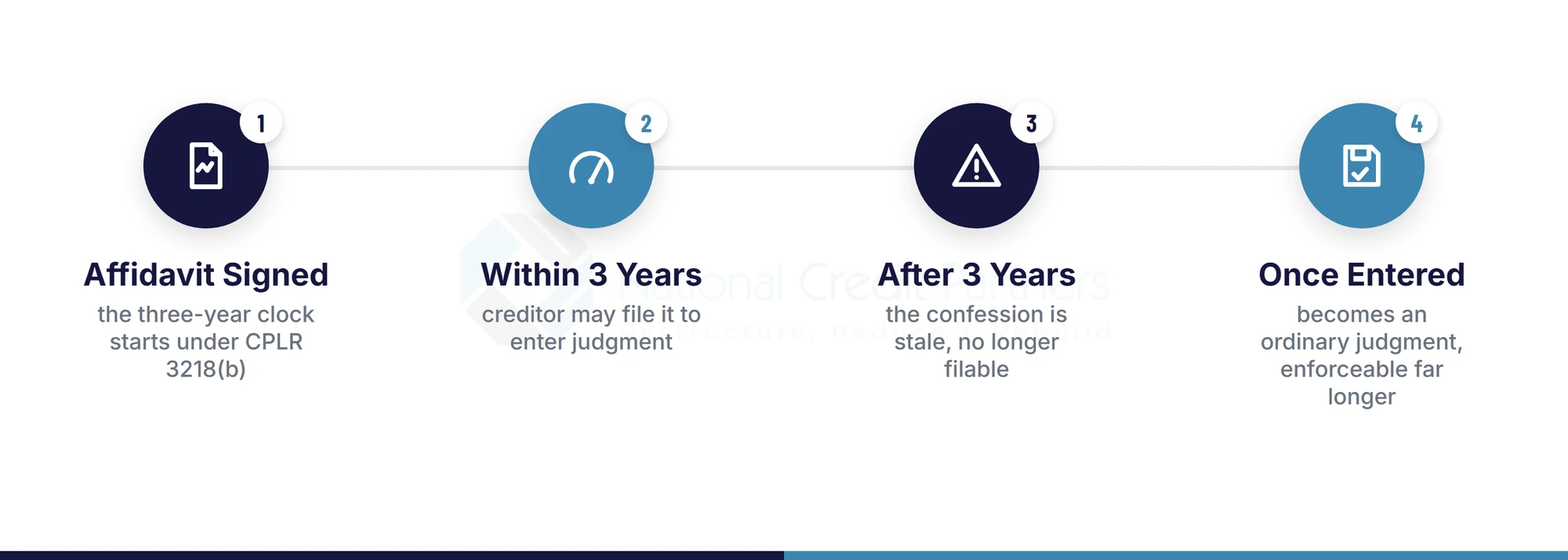
Under CPLR 3218(b), a confession of judgment can be filed and entered only within three years after the affidavit is executed. After three years, the confession itself is stale and can no longer be turned into a judgment. This three-year window applies to the confession document, and it is why creditors backing a longer payment plan, say four or five years, sometimes ask for a fresh confession before the first one expires.
A creditor also cannot enter judgment on a confession if the debtor has died. Note the important distinction between the confession and the judgment it produces: the three-year limit governs how long the creditor has to convert the signed affidavit into an entered judgment. Once a judgment is actually entered, it becomes a money judgment enforceable under New York's ordinary rules, which allow enforcement for far longer than three years and permit renewal. So the short answer to "how long is a confession of judgment good for in New York" is three years from signing to enter it, but the resulting judgment, once entered, endures on its own timeline.
If a confession of judgment has already been entered against you, the usual path to challenge it is a motion to vacate, and the practical grounds tend to be procedural rather than a dispute about whether you owe the money. Because New York courts require strict compliance with CPLR 3218, defects worth having a business debt attorney examine include: whether you were a New York resident (or your entity had a New York place of business) when you signed a post-2019 confession; whether the affidavit was filed in the correct county; whether it was altered after signing; whether it was a proper original notarized affidavit; and whether it was filed within the three-year window. As the New York cases show, some of these challenges succeed and some do not, so a review of the specific filing by qualified counsel is the honest starting point. This page is general information, not legal advice.
Beyond the courtroom question of vacating a judgment, there is the underlying debt itself, and this is where the two problems diverge. A merchant cash advance balance that produced the COJ often carries an effective cost far above what a business can sustain, and even a successfully vacated judgment leaves that debt in place. National Credit Partners works with owners in that position through structured reconciliation: negotiating directly with your creditors to replace unaffordable business debt with modified terms your cash flow can actually carry, with the aim of having advances marked paid in full rather than settled for less. We are not a law firm and we do not provide legal representation on the judgment itself; where a COJ stemming from an MCA or other business debt is threatening your operations, talk to us about your situation and we will walk you through what a restructuring path could look like.
A New York confession of judgment is powerful precisely because it removes the safeguards a lawsuit would give you, and the 2019 reform closed only one avenue of abuse rather than the tool as a whole. If you are a New York resident, or your business has a New York footprint, the risk is still real, and the strongest defenses are usually procedural and time-sensitive. Treat a signed or filed COJ as urgent: get the filing reviewed by counsel for statutory defects, and address the debt that created it before the next default converts into a judgment you cannot easily undo.
How long is a confession of judgment good for in New York?
Under CPLR 3218(b), a New York confession of judgment can be filed and entered as a judgment only within three years after the affidavit is signed. After three years the confession is stale and can no longer be turned into a judgment. However, once a judgment has actually been entered from the confession, it becomes an ordinary New York money judgment that can be enforced and renewed for much longer.
How does a confession of judgment work?
The debtor signs a sworn affidavit admitting a specific amount is owed and authorizing the creditor to enter judgment for that amount. The creditor holds the affidavit and, on a default, files it with a New York county clerk to obtain an entered judgment directly, with no lawsuit, no hearing, and no chance for the debtor to contest liability first. Once entered, it is enforced like any other money judgment.
What states allow a confession of judgment?
Confessions of judgment are permitted in many U.S. states, including New York (under CPLR 3218), New Jersey, and Pennsylvania. Some states impose extra formalities or restrictions, and several prohibit them in consumer credit transactions. New York still allows them in commercial matters but, since 30 August 2019, bars entry of a confession signed by a defendant who did not reside in New York when they signed it.
What is an example of a confession of judgment clause?
A confession of judgment clause typically reads to the effect that the debtor confesses judgment in favor of the named creditor for a stated sum, acknowledges the debt, and consents to entry of judgment without prior notice or an opportunity to defend. In New York the affidavit must also state the county where the debtor resided when it was signed and the facts out of which the debt arose, as CPLR 3218 requires strict compliance.
Did New York ban confessions of judgment in 2019?
Not entirely. The 2019 amendment to CPLR 3218 (effective 30 August 2019) made confessions of judgment unenforceable when signed by parties who did not reside in New York at the time, ending the practice of out-of-state creditors filing them against out-of-state small businesses in New York. Confessions of judgment signed by New York residents, or by entities with a New York place of business, remain enforceable.
Can you fight a confession of judgment in New York?
Yes. The usual route is a motion to vacate the entered judgment, and because New York courts require strict compliance with CPLR 3218, the strongest grounds are typically procedural: the wrong county, an altered affidavit, missing statutory details, a lapse of the three-year window, or a signer who was not a New York resident for a post-2019 confession. Some challenges succeed and some fail, so have a qualified business debt attorney review the specific filing.
An A+ rating represents BBB's high degree of confidence that the business is operating in a trustworthy manner and will make a good faith effort to resolve any customer concerns filed with the BBB.