

A UCC lien is a public claim a creditor files against your business assets to secure a debt. It does not take your property outright, but it gives the filer a legal priority over those assets, can block new financing, and, on default, can be enforced against your receivables. This guide explains what a UCC lien means, how merchant cash advance funders use them, how to check for one, and how to have an improper or paid-off lien removed.
A UCC lien is a creditor's public claim on your business property, recorded so that everyone else can see that claim exists. The name comes from the Uniform Commercial Code, the body of commercial law adopted in some form by every U.S. state, and specifically from Article 9, which governs secured transactions. When a lender wants collateral for a loan, it files a form called a UCC-1 financing statement with your state's Secretary of State. That filing is the lien.
The distinction that trips up most business owners is this: the UCC-1 is a notice, not a seizure. Filing one does not hand your equipment or your bank balance to the creditor. What it does is register the creditor's security interest so it becomes enforceable against you and, critically, against other creditors. Lawyers call this step perfection. As the Legal Information Institute at Cornell Law School explains, perfection through a UCC filing is what determines priority: which creditor gets paid first from the collateral if you default or become insolvent.
Priority is the whole point. A perfected UCC lien puts its holder ahead of unsecured creditors and ahead of any later filer against the same assets. That is why a lender who does not file promptly can be leapfrogged by one who does. For you, the borrower, the practical effect of a live UCC-1 is that the named collateral is spoken for. You can still run your business and use the assets, but you cannot cleanly pledge them again, and any new lender running a search will see the existing claim.
If a UCC lien turned up against your business and you did not take out a conventional bank loan, the source is very often a merchant cash advance. MCA funders treat the UCC-1 as standard operating procedure. It is filed at funding, sometimes within hours of the money hitting your account, and it is usually written broadly.
The reason is structural. An MCA is legally framed as the purchase of your future receivables rather than a loan, and the funder's exposure is entirely uncollateralized cash it has already advanced. The UCC-1 is how it converts that exposure into a secured position. By filing against your receivables and other assets, the funder gains priority if you stop paying and, more importantly, gains a legal foothold to enforce collection. The lien is the instrument behind the daily ACH debits, the payoff demands, and the payment-redirection notices that follow a default.
This matters most when a business has taken more than one advance, a pattern known as stacking. Each funder files its own UCC-1. Now you have multiple liens competing for priority over the same receivables, each holder convinced it has first claim, and each willing to act on that belief. Untangling a stack of competing UCC liens is one of the harder problems a distressed business faces, because the funders' interests conflict with each other as much as with yours.
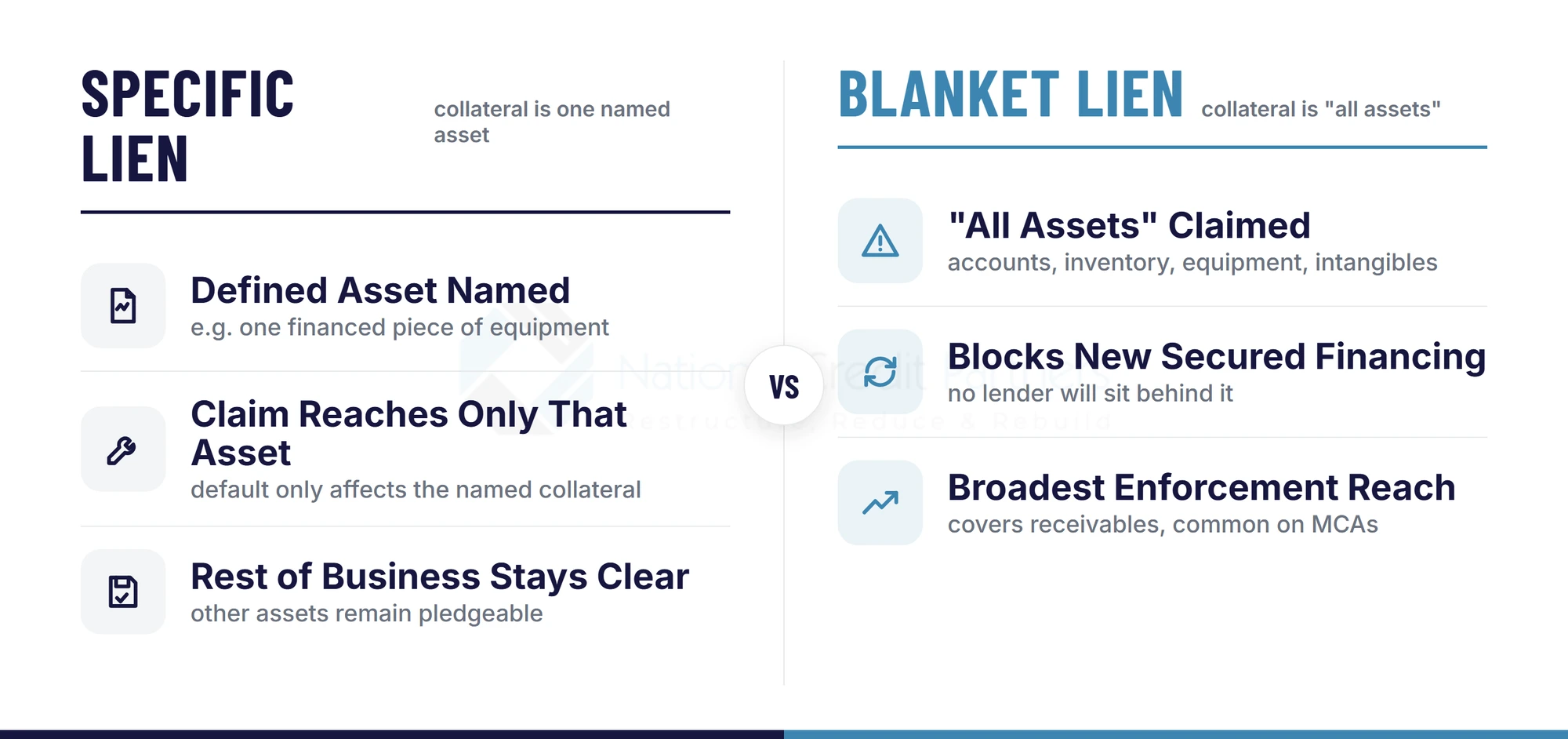
Not all UCC liens are equal, and the difference decides how much of your business is exposed. It comes down to how the collateral is described on the filing.
A specific lien names a defined asset. An equipment lender that finances a commercial oven files a UCC-1 describing that oven. If you default, the lender's claim reaches that piece of collateral and nothing else. The rest of your assets stay clear. This is the narrower, less dangerous form, and it is what a careful borrower should push for whenever the collateral genuinely is one identifiable thing.
A blanket lien is the opposite. Instead of naming an asset, it claims a security interest in "all assets" or "all personal property" of the business, typically listed as accounts, inventory, equipment, and general intangibles. One filing, and the creditor's claim now covers effectively everything the company owns. Blanket liens are common on unsecured business loans and are close to universal on merchant cash advances, because a funder with no specific collateral wants the widest net it can cast.
The blanket lien is more dangerous for two reasons. First, it locks up your entire asset base, so no other lender will extend secured financing behind it, which is often exactly when a distressed business needs new capital most. Second, because it reaches your accounts and receivables, it is the type of lien that supports the most aggressive enforcement, including the payment redirection covered next. If you are trying to work out of a debt problem, knowing whether the filings against you are specific or blanket is one of the first things to establish, because it defines the size of the problem.
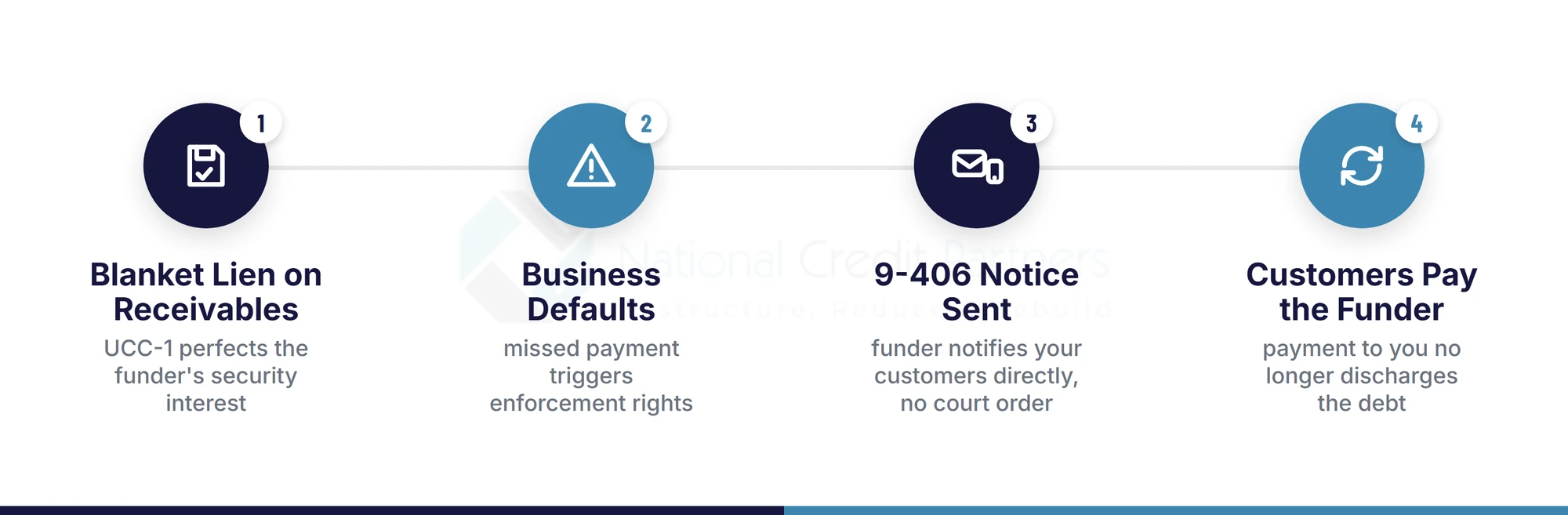
A UCC lien sits quietly until there is a default. Then it becomes the legal basis for enforcement, and the sharpest tool a secured party holds over a business with a blanket lien on its receivables is UCC Section 9-406.
Section 9-406 of Article 9 addresses what happens when receivables are the collateral. In plain terms: when a creditor has a perfected security interest in your accounts receivable, it can send a notice to the people who owe you money, your customers and account debtors, instructing them to pay the creditor directly instead of you. Once that notice is properly delivered, your customer discharges its obligation by paying the secured party. Paying you no longer counts. The customer is legally protected for redirecting the money, and you have no clean claim to demand it back.
For a business, the effect is immediate and severe. The lien holder does not need a court order to send a 9-406 notice; the authority flows from the perfected security interest the UCC-1 established. Your incoming cash is intercepted at the source, before it ever reaches your account, and your customers learn that your business is in trouble. This is why a blanket UCC lien on receivables is far more than a paperwork nuisance. It is a live mechanism that can starve a company of revenue within days. Understanding that enforcement path is the reason the lien matters in the first place, and it is covered in more depth in our explainer on UCC Article 9 and secured transactions.
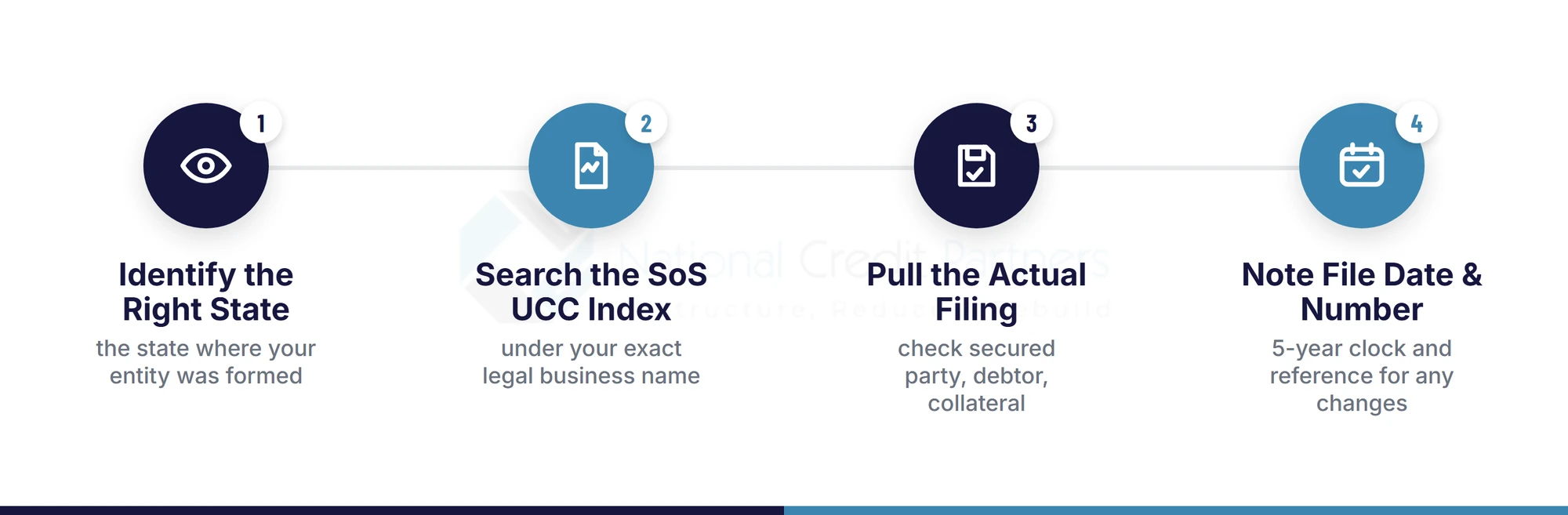
UCC filings are public record, and you do not need a lawyer or a paid service to find them. The filings are held by the Secretary of State in the state where your business is organized, and most states let you search the UCC index online for free or a small fee.
Work through it in order:
If you find a filing you do not recognize, do not assume it is a mistake, and do not assume it is legitimate either. MCA funders sometimes file under trade names, and errors and stale filings are common. The point of the search is to build a complete, accurate list of every claim against your assets, which is the foundation for doing anything about them.
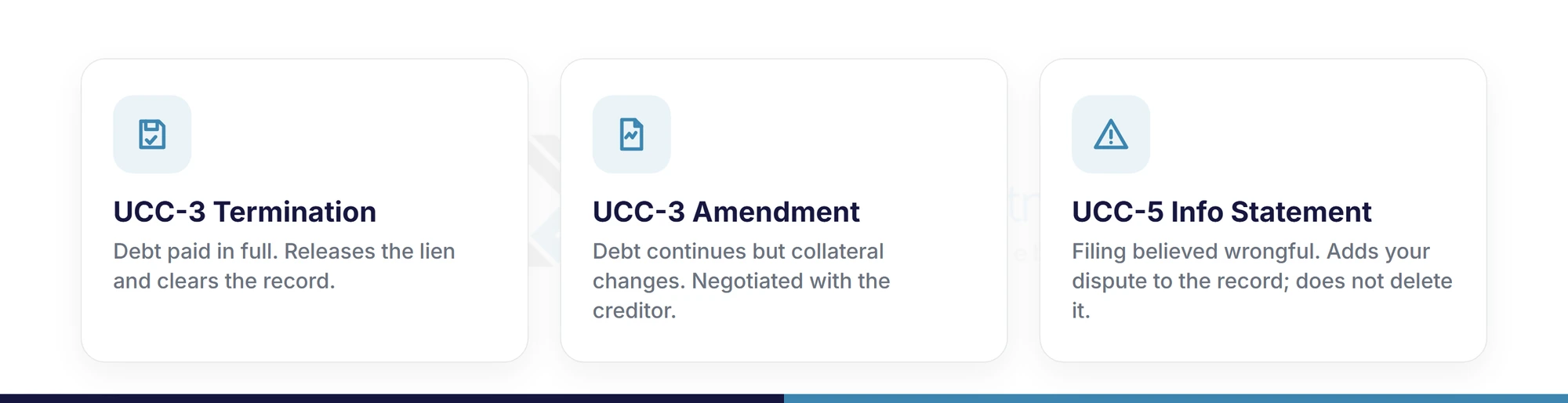
A UCC lien does not remove itself, and it does not automatically disappear when you finish paying the debt. Getting one off your record takes a specific action, and which action depends on the situation.
When the debt is paid, the fix is a UCC-3 termination statement. The UCC-3 is the amendment form used to change or end an existing financing statement, and checking the termination box releases the lien. Under Article 9, a secured party that has been paid in full is generally obligated to file the termination, but in practice creditors forget, and a satisfied lien can sit on your record for years, quietly blocking new financing. If a lien for a debt you have already cleared is still showing, contact the secured party in writing, reference the file number, and request the UCC-3 termination. If they refuse or ignore you, Article 9 gives a paid debtor the right to have the filing terminated.
When the collateral needs to change but the debt continues, a UCC-3 amendment is the tool. This is how a blanket lien can be narrowed, releasing specific assets, often as part of substituting collateral. That kind of change is negotiated with the creditor rather than filed unilaterally, but the UCC-3 is the mechanism that records the outcome.
When a filing is wrong or should never have been made, there is a separate remedy. A UCC-5 information statement lets a debtor who believes a financing statement was filed wrongfully or in error add a statement of record to the filing. It is important to understand its limits: a UCC-5 does not delete the filing. It attaches your position to the record so anyone searching sees the dispute. Removing an improper filing outright usually requires the filer to withdraw it or, if they will not, a legal challenge.
This is where a UCC lien tied to a merchant cash advance becomes a debt problem rather than a filing problem. You cannot terminate an active MCA lien while the balance is outstanding, and simply defaulting invites the 9-406 enforcement described above. The durable path is to resolve the underlying debt so the lien can be released. Through structured reconciliation, we negotiate directly with your funders to replace unaffordable advances with modified terms marked paid in full, which is what allows the UCC-3 termination to follow. That is a different outcome from settling a balance for less, and it is the approach we take. If a UCC lien on your business stems from an MCA or other business debt you can no longer service, contact us for a free, no-obligation consultation and we will walk through your specific filings and options with you.
A UCC lien is not, by itself, a business emergency. It is a legal notice, and for a healthy company borrowing on ordinary terms it is simply part of the paperwork. What changes the picture is the scope of the filing and the debt behind it. A blanket lien on your receivables, filed to secure a merchant cash advance you can no longer afford, is a very different thing from a specific lien on a financed machine. Know which one you are dealing with, know where it is filed, and know that the durable way to clear an MCA lien is to resolve the debt so the termination can follow, not to default and trigger enforcement. If you are not sure where your business stands, start with a UCC search in your state of organization and build an accurate list of every claim against you. That list is where any real solution begins.
Can a UCC lien take money from your bank account?
Not directly by itself. A UCC lien is a claim on collateral, not a seizure. But if the lien covers your receivables, the secured party can use a Section 9-406 notice to redirect payments your customers owe you, intercepting income before it reaches your account. Some agreements also authorize ACH debits from the business account. So while the filing alone does not empty your account, the enforcement rights it secures can cut off your incoming cash.
What is the purpose of a UCC lien?
Its purpose is to give a creditor a perfected, public security interest in a debtor's business property so the creditor has priority over that collateral if the debtor defaults or other creditors make competing claims. It is a notice to the world that the creditor has a stake in specific, or in the case of a blanket lien, all of a business's assets.
Is a UCC filing good or bad?
A UCC filing is neutral on its own. It is a routine part of secured business lending, and having one does not directly lower your personal credit score. It becomes a problem when it is a broad blanket lien, when it ties up assets you need to pledge for new financing, or when it secures aggressive debt such as a merchant cash advance. Context decides whether a given filing is harmless or a real constraint.
How long does a UCC lien last?
A standard UCC financing statement is effective for five years from the filing date. To keep it alive beyond that, the creditor must file a continuation statement within the six months before it lapses. Some categories, such as manufactured-home and public-finance transactions, run for 30 years. If a creditor lets a lien lapse without continuing it, the security interest is no longer perfected.
How do I get a UCC lien removed after I pay off the debt?
The lien is released by filing a UCC-3 termination statement. A secured party paid in full is generally required to file it, but if they do not, contact them in writing with the filing number and request the termination. A paid debtor has the right under Article 9 to have a satisfied filing terminated. For an active debt such as an MCA, the lien cannot be terminated until the underlying balance is resolved.
What is the difference between a blanket UCC lien and a specific lien?
A specific lien names one defined asset as collateral and reaches only that asset. A blanket lien claims all of a business's assets, such as accounts, inventory, equipment, and general intangibles, in a single filing. Blanket liens are more dangerous because they lock up your entire asset base, block new secured financing, and support the broadest enforcement, including receivables redirection.
An A+ rating represents BBB's high degree of confidence that the business is operating in a trustworthy manner and will make a good faith effort to resolve any customer concerns filed with the BBB.