

A UCC 9-406 notice is a letter that tells your customers to stop paying you and send their payments to a lender or funder instead, redirecting the receivables your business runs on. It carries real weight under Article 9 of the Uniform Commercial Code, but it only reflects a right to payment that already exists — it does not create one, and that distinction is the key to responding correctly.

A UCC 9-406 notice is a written directive, sent by a party that claims it has been assigned the right to your receivables, instructing your customers to pay that party directly instead of paying you. The name comes from Section 9-406 of the Uniform Commercial Code (UCC), the body of commercial law adopted in every US state that governs secured transactions.
In plain terms, a company your customer has never dealt with sends a letter that says: stop paying your vendor, pay us instead. For the business whose receivables are being redirected, it is often the first hard sign that a lender is enforcing against the lifeblood of the company — the money owed by its customers. For the customer who receives it (the "account debtor" in the statute's language), it raises an immediate and practical question: do I have to comply, and who am I actually supposed to pay?
These notices have become far more common as merchant cash advance funders and receivables factors use them to collect. Below is what the statute actually says, why the notice can be so disruptive, and what to do next — whether you are the business on the receiving end of the enforcement or the customer holding the letter.

Section 9-406 sits inside Article 9 of the UCC, the part of the code that governs security interests in business assets, including accounts receivable. The full section is dense, but four ideas drive almost every real-world dispute.
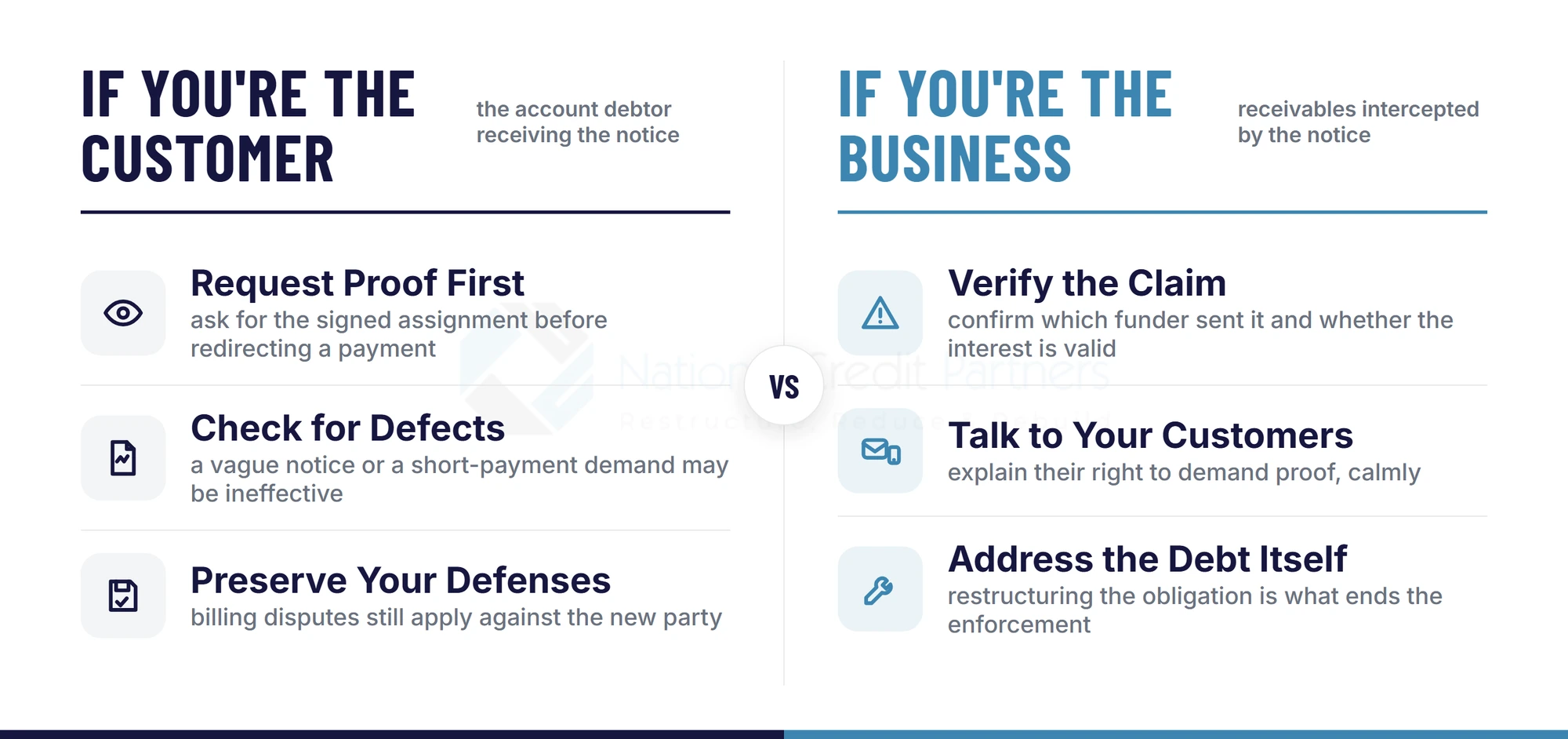
A customer (account debtor) may pay the original business — the "assignor" — and be fully discharged, until, but not after, the customer receives an authenticated notification that the amount owed has been assigned and that payment is to be made to the new party (the "assignee"). Once a valid notice arrives, the customer can discharge the debt only by paying the assignee; paying the old vendor no longer counts. "Authenticated" simply means signed, which includes a valid electronic signature.
A notice is not automatically binding. Subsection (b) makes a notification ineffective if it does not reasonably identify the rights assigned. And at the account debtor's option, a notice is ineffective if it directs the customer to pay the assignee less than the full amount of an installment or other periodic payment. These are not trivial technicalities — a vague or partial notice may not obligate a customer to redirect anything.
This is the most important protection, and the one most often overlooked. If the account debtor requests it, the assignee must "seasonably" (promptly) furnish reasonable proof that the assignment was actually made. Until the assignee provides that proof, the customer may keep paying the original business and still be discharged — even after receiving the notice. A filed UCC financing statement, on its own, is not sufficient proof; the assignee generally has to produce the signed agreement that assigned the receivables.
Subsection (d) makes most contract terms that prohibit or restrict assignment ineffective. So a clause in your customer contract saying "receivables cannot be assigned" typically will not block a lender's security interest. This is why receivables can be pledged or sold even when the underlying contract appears to forbid it.
You can read the full text of the statute at the Legal Information Institute's copy of UCC §9-406. State versions — in Texas, Florida, Oregon and elsewhere — follow the same uniform structure with local numbering.

The harshest feature of Section 9-406 is the double-payment risk. If a customer receives a valid, authenticated notice and ignores it — continuing to pay the original vendor — that payment does not discharge the debt. The assignee can still demand payment, and the customer may have to pay the same invoice a second time, then try to claw back the first payment from a vendor that may already be in financial trouble.
That single rule is what gives these notices their power. A customer's accounts-payable team, unsure what to do, freezes the payment or redirects it "to be safe." For the business that was counting on that money, the receivable flow it depends on to make payroll and pay suppliers can seize up almost overnight.
Importantly, the assignee never gets greater rights than the original business had. Under UCC §9-404, the customer keeps every defense and claim it had against the original vendor — billing disputes, offsets, undelivered goods — and can raise them against the assignee too. A 9-406 notice does not erase a legitimate dispute over the invoice; it simply changes who is trying to collect.
In a large share of cases today, the party sending the notice is a merchant cash advance funder. An MCA is not a loan in the traditional sense — it is the purchase of a portion of your future receivables at a discount, repaid through daily or weekly ACH debits. When a business falls behind on those debits, the funder often turns to a 9-406 notice to collect straight from the source: the business's own customers. If you want the full picture of how these advances work, see our explainer on what MCA debt is.
Here is the complication. An MCA funder that files a UCC-1 and sends a 9-406 notice is asserting a secured claim to your receivables — but sending the notice is not the same as holding a valid, senior, perfected right to those payments. Many distressed businesses have taken more than one advance, so several funders may all claim the same receivables at once. Whether any single funder actually has priority is a fact-specific legal question, not something the letter itself settles.
This is the core point the strongest analyses agree on: a 9-406 notice reflects a right to payment; it does not create one. If the underlying right is weak, missing, or subordinate to another creditor, the notice may not entitle the sender to a single dollar — yet it can still disrupt a business simply by creating confusion among its customers. A 9-406 notice is also just one enforcement tool among several a funder may hold, alongside a UCC lien and, in some older agreements, a confession of judgment.
If you are the business owner, a 9-406 notice sent to your customers is one of the most alarming moments in an MCA problem. It feels like your funder has reached past you and seized the revenue you were relying on. The panic is understandable — but the situation is more contestable than the letter implies.
First, the notice does not shut down your business or transfer ownership of anything. It is a payment-direction demand, and its effect depends entirely on whether the sender genuinely holds the assigned right and whether the notice meets the statute's requirements. A defective notice, or one from a funder without a valid senior interest, may be open to challenge.
Second, your customers have the right to demand proof before they redirect a cent, and many notices quietly fail that test. Your customers also keep every defense they had against you, so the notice cannot manufacture money out of a disputed invoice.
Third — and this matters most — the notice is a symptom, not the disease. The real problem is the underlying debt that triggered enforcement, usually an unaffordable MCA or a stack of them. Stopping the bleeding for one billing cycle does nothing if the debt behind it is still pulling your account apart. Resolving that debt is what actually stabilizes the business.
This is educational information, not legal advice. Section 9-406 interacts with other statutes and varies by state, and the right move depends on your specific facts — review your situation with a qualified attorney before you act.
A 9-406 notice is enforcement. It appears because a debt — most often an MCA — has reached the point where the funder is collecting from your customers. Contesting the letter can buy time; resolving the debt is what ends the crisis.
This is the work National Credit Partners does. Rather than settling accounts for less, NCP negotiates directly with funders and creditors to restructure the underlying advances into terms a business can actually service, with the goal of having positions marked paid in full. For a business staring at redirected receivables, that is the difference between limping through one billing cycle and putting the whole problem behind it — staying in good standing, keeping the doors open, and protecting the ability to qualify for future financing.
The approach leans on a network of attorneys and negotiators who deal with MCA funders and secured creditors routinely, and it begins with a no-cost, confidential review of where your positions actually stand and what can be restructured. Businesses that reach this point usually carry $50,000 or more in stacked business debt — exactly the situation this paid-in-full model is built to unwind. National Credit Partners holds a BBB A+ rating.
If a 9-406 notice has your customers asking who to pay, the fastest way to protect your business is to deal with the debt driving it. Book a free, confidential consultation for a straight assessment of your options.
What does UCC 9-406 mean?
UCC 9-406 is the section of the Uniform Commercial Code that governs how a customer (account debtor) is discharged when the right to their payment has been assigned to another party. In short: once the customer receives a valid, signed notice that payments now go to an assignee, they can discharge the debt only by paying that assignee — not the original business.
What is a 406 notice?
A "406 notice" is shorthand for a UCC 9-406 notice: a letter directing a business's customers to redirect their payments to a lender, funder, or factor that claims an assignment of those receivables. It is most often used by merchant cash advance funders and receivables factors to collect directly from a business's customers.
Do I really have to pay a third party — or pay the same invoice twice?
Not automatically. You only owe the assignee if the notice is valid and the assignment is real. You have the right to request reasonable proof of the assignment; until it is provided, you can generally keep paying the original business and stay discharged. But once a valid notice has been served and proven, paying the original vendor instead of the assignee will not discharge the debt — and you could be required to pay again. Confirm your position with an attorney before changing who you pay.
What is the purpose of Article 9 of the UCC?
Article 9 governs secured transactions — the rules for how lenders take, perfect, and enforce a security interest in a business's assets, including accounts receivable, equipment, and inventory. Section 9-406 is the piece that lets a secured party or a buyer of receivables collect directly from the account debtor.
What is an assignment of promissory notes?
An assignment transfers the right to receive payment under a note or account from the original holder to another party. Section 9-406 also makes most contract terms that try to prohibit such assignments ineffective, which is why receivables and notes can usually be pledged or sold even when the underlying agreement appears to forbid it.
Can you ignore a UCC 9-406 notice?
Ignoring a valid notice is risky — it is the fastest route to the double-payment problem. The safer path is to verify: request proof of the assignment promptly and review the notice for defects. Silence is not a strategy; verification is.
An A+ rating represents BBB's high degree of confidence that the business is operating in a trustworthy manner and will make a good faith effort to resolve any customer concerns filed with the BBB.